1.4 Billion Selectors: Why Every Indian Is an Unpaid National Cricket Coach
Satire / opinion, not factual reporting. AI-assisted, for curiosity, not authority.
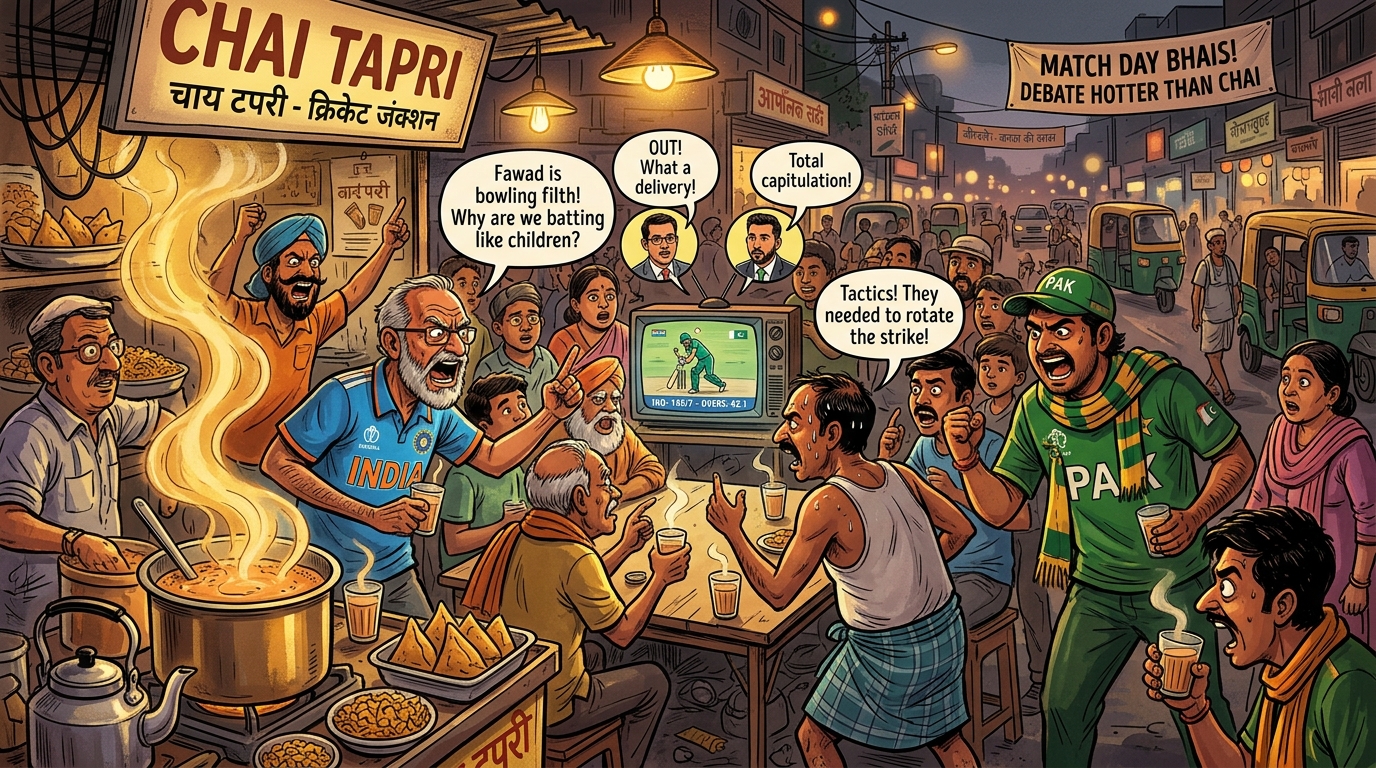
There is an old anthropological truism that while most nations possess a government, a currency, and a flag, the Indian subcontinent possesses something far more binding: an informal shadow cabinet of one billion four hundred million senior cricket selectors.
At any given second on a tournament match day, across thousands of roadside tea stalls, suburban living rooms, and office cafeteria corners, an astonishing transformation occurs.
A quiet accountant who avoids confrontation with his apartment society treasurer suddenly slams his tea glass onto a wooden bench and bellows at a television screen:
“Why is he giving the fourteenth over to a left-arm spinner when the pitch is clearly gripping for cross-seam medium pace? Complete tactical bankruptcy! I would have brought in a slip and bowled tight yorkers on off-stump!”
The speaker has not bowled a leather ball since the late eighties, suffers from acute lower back stiffness, and gets winded climbing two flights of stairs. Yet in this magical moment, he speaks with the unshakeable clinical conviction of a veteran test captain dissecting a World Cup final.
Welcome to the grandest psychological theatre on earth: the unpaid, unappointed, and utterly unhinged national selection committee.
The Anatomy of the Tea-Stall Tactician
The phenomenon begins at the local chai tapri, that sacred democratic forum where all social hierarchies collapse before the almighty drama of an eight-run-per-over required run rate.
Gathered around a twenty-four-inch LED screen bolted to a concrete wall, you will find an eclectic assembly of geopolitical strategists:
- A college undergraduate who failed his engineering mathematics midterm diagnosing the precise rotational aerodynamics of a reverse-swinging yorker.
- A retired civil servant who spent thirty-four years processing paperwork explaining why an elite opening batsman lacks the moral fortitude required for pressure situations.
- An auto-rickshaw driver offering an impromptu masterclass on field placement: “Look where mid-on is standing! Too wide! You are inviting the lofted drive!”
What makes this spectacle extraordinary is the total absence of hesitation. Nobody ever whispers, "Well, the captain possesses twenty years of professional experience and has studied hours of analytical data, so perhaps he knows best."
To utter such a sentence in an Indian gathering would be deemed an act of emotional treason. In the republic of cricket fandom, self-doubt is banned. Every citizen believes, in the deepest marrow of their bones, that given twenty minutes alone with the team sheet and a dry-erase marker, they could orchestrate victory across five continents.
The WhatsApp War Room
In the modern digital era, this armchair tactical brilliance has migrated from physical street corners into the dense foliage of WhatsApp family chat groups.
The moment the national squad loses two quick wickets inside the powerplay, your phone begins vibrating like an industrial turbine. Within forty-five seconds, an assortment of uncles, cousins, and distant second-degree relatives begin broadcasting urgent administrative communiqués:
- “Drop the number four batsman immediately. He has zero situational temperament.”
- “Why was the all-rounder rested? Total nepotism in the selection committee.”
- “Forwarding this 8-minute voice note from my friend whose brother-in-law knows a junior physiotherapist at the National Cricket Academy: here is what really happened in the dressing room.”
During a tense run chase, these family chat threads cease to be channels for wedding photos and birthday greetings; they turn into operational war rooms. Every dot ball is greeted with tragic lamentations worthy of a Greek chorus; every boundary is hailed as a vindication of the uncle's tactical advice typed three overs earlier.
The Psychology of Surrogate Governance
Why does a nation of over a billion people invest such immense, visceral emotional energy into micro-managing eleven young athletes running between wooden pegs on a patch of grass?
Social psychologists have long pointed out that sport functions as a vehicle for surrogate agency. In daily Indian life, the average citizen contends with massive systems over which they exercise virtually zero direct control: sprawling urban traffic jams, municipal water shortages, bureaucratic red tape, and fluctuating grocery prices. You cannot yell at the municipal corporation and magically fix a potholed highway; you cannot lecture the global economy on inflation.
But on the cricket field, the entire universe is compressed into twenty-two yards and three hundred balls.
Rules are definite. The outcome is decided in four hours. Accountability is instantaneous: a batsman either defends the ball or his stumps are shattered into splinters for all to see. In that compressed, theatrical arena, the fan experiences the thrilling illusion of total mastery.
By shouting at the screen, analyzing field settings, and passionately demanding that the coach be sacked before tea time, the ordinary citizen reclaims a momentary sense of command over destiny.
For those four exhilarating hours, they are not a commuter stuck in gridlock or an employee buried beneath corporate spreadsheets; they are the Supreme Commander of Indian Cricket, steering the ship through treacherous waters with nothing but an empty chai glass and the righteous fire of pure conviction.