Timelines
How it all started
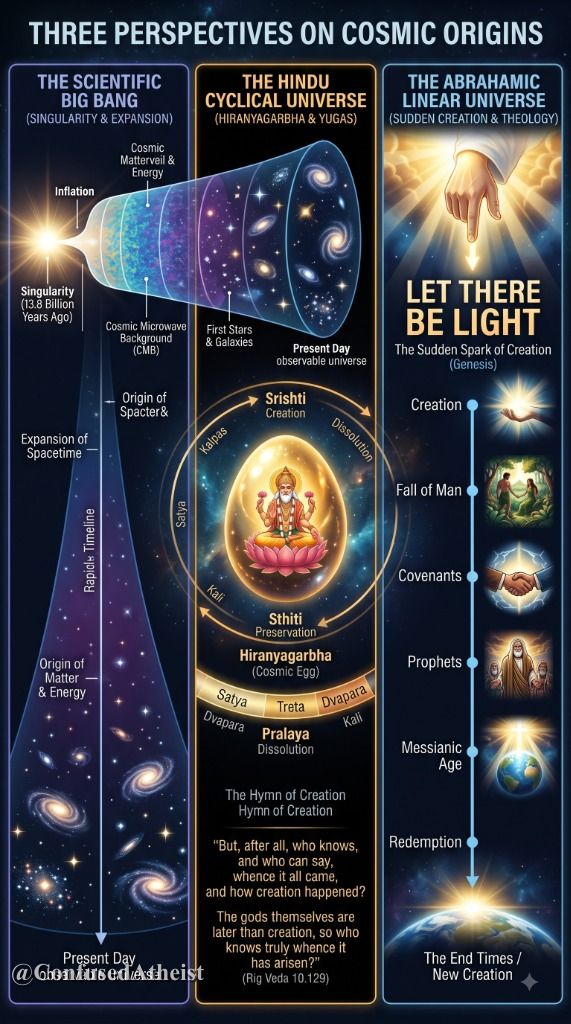
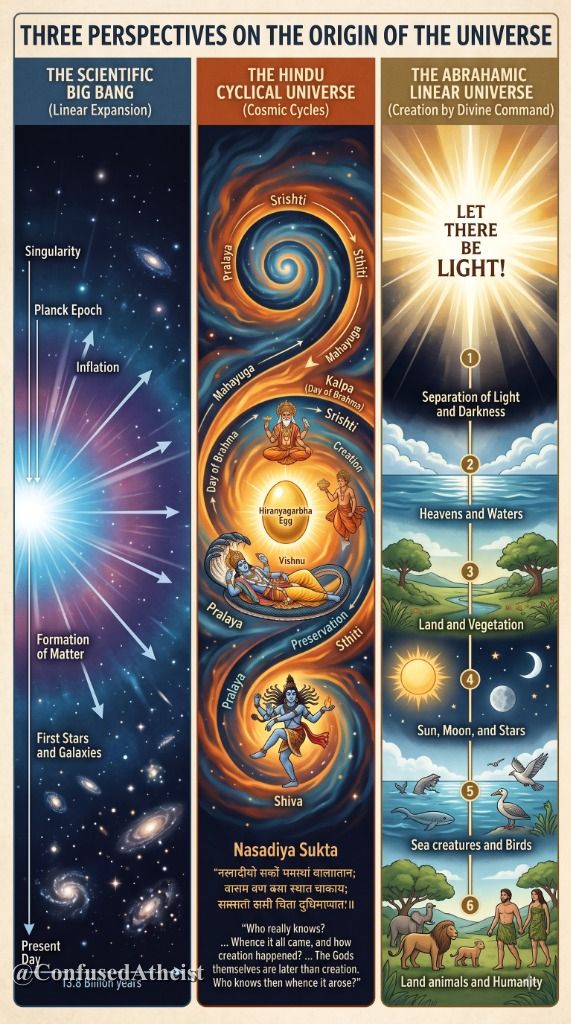
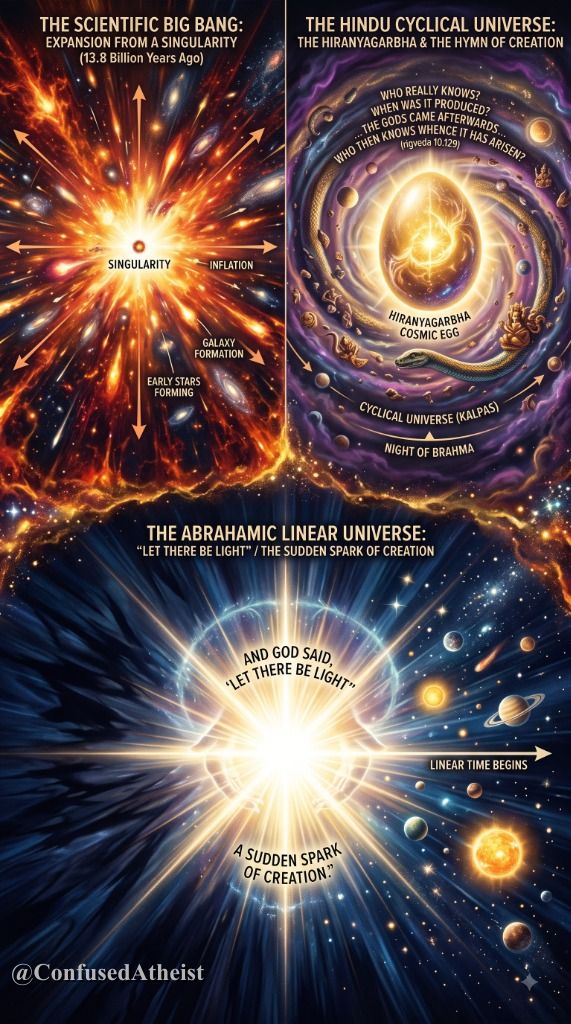
Explore how ancient myths mirrored the scientific Big Bang. The universe hatched from a Cosmic Egg, or began with a sudden spark of light.
Deep-Dive Interactive Chronologies
Rich, multi-tab timelines with historical evidence, sacred geography, and critical historiography.
The Ramayana
The 7 Kandas, 10-point sacred geography trail, and astronomical dating debates.
Explore Timeline →The Mahabharata
The 18 Parvas, 18 days of Kurukshetra, and ASI excavations at Hastinapur.
Explore Timeline →History of Buddhism
7 life milestones with Pali verses, 4 councils, and Ashokan edict trails.
Explore Timeline →The World Wars Series
World War I, World War II, Vietnam, and Kargil—from trenches to nuclear deterrence.
Explore Wars Hub →Indus-Saraswati to PGW
Mehrgarh, Mature Harappan grids, the 4.2-kyr drought, and Painted Grey Ware sites.
Explore Timeline →Schools of Indian Philosophy
Charvaka materialism, Vaisheshika atomism, Nyaya logic, Buddhism, Jainism & Vedanta.
Explore Timeline →The Dashavatara Sequence
From Vedic Prajapati myths to Puranic Vaishnavism and the evolutionary parallel debate.
Explore Timeline →The 9 Nights of Navratri
Day-by-day spiritual evolution of the Goddess through the 9 Navadurga forms.
Explore Timeline →Historical Timeline
Göbekli Tepe
The world's oldest known megalithic temple complex in southeastern Anatolia, predating agriculture.
Invention of Writing (Sumer)
The development of Cuneiform script in Mesopotamia, marking the transition from prehistory to recorded history.
Great Pyramid of Giza
Construction of the largest Egyptian pyramid, serving as a monumental tomb.
Mature Indus Valley Civilization
The peak of urban planning and hydro-engineering in cities like Mohenjo-Daro and Harappa in the Indian Subcontinent.
Composition of the Rigveda
The earliest roots of Indian philosophy and hymns begin to take oral form in the northwestern subcontinent.
The Axial Age
A pivotal period of philosophical and religious development across India (Upanishads), China (Confucius, Laozi), and Greece (Socrates).
Alexander the Great's Conquests
The Macedonian king conquers the Persian Empire and reaches the northwestern borders of India.
The Maurya Empire & Ashoka
Emperor Ashoka unites most of the Indian subcontinent and pivots from brutal conquest to policies of non-violence (Dhamma).
The Roman Empire
The expansion of Rome into a massive empire surrounding the Mediterranean Sea, driving early globalization.
The Gupta Empire
A period of extensive inventions and discoveries in science, technology, engineering, art, and mathematics in India.
The Islamic Golden Age
A period of cultural, economic, and scientific flourishing in the history of Islam.
The Renaissance
A fervent period of European cultural, artistic, political and economic rebirth following the Middle Ages.
The Mughal Empire
A period of vast wealth, cultural syncretism, and monumental architecture in India, culminating in structures like the Taj Mahal.
The Industrial Revolution
The transition to new manufacturing processes in Great Britain, continental Europe, and the United States.
The British Raj
Direct rule by the British Crown over the Indian subcontinent, radically transforming its economy and borders.
Independence of India
After decades of struggle, India gains independence, birthing a secular, democratic republic.
The Information Age
The shift from traditional industry to an economy based on information technology.
Future explorations
Spiritual Timeline
Srishti (Creation) & Satya Yuga
Brahma creates the universe. The first age of truth features the avatars Matsya, Kurma, Varaha, and Narasimha.
Treta Yuga & The Ramayana (est. ~5114 BCE)
The age of mankind. Features Vamana, Parashurama, and the epic journey of Rama to defeat Ravana.
Dvapara Yuga & The Mahabharata (est. ~3139 BCE)
The great Kurukshetra War between the Pandavas and Kauravas. Krishna delivers the Bhagavad Gita.
Dawn of Kali Yuga (3102 BCE)
The traditional start of the current age of spiritual decline, marked by the departure of Krishna.
Abraham and the Covenant (est. 2000-1500 BCE)
Considered the founding father of the Covenant, marking the mythological and historical roots of the Abrahamic religions (Judaism, Christianity, Islam).
Zoroaster & Zoroastrianism (est. 1500-1000 BCE)
Zoroaster founds one of the world's oldest continuously practiced monotheistic religions in ancient Iran.
Moses and the Exodus (est. ~1300 BCE)
Moses leads the Israelites out of slavery in Egypt and receives the Ten Commandments at Mount Sinai.
Laozi & Daoism (est. 6th Century BCE)
The legendary figure Laozi writes the Tao Te Ching, forming the foundation of Daoist philosophy.
Mahavira & Jainism (est. 599 - 527 BCE)
Vardhamana Mahavira becomes the 24th Tirthankara, emphasizing strict non-violence (Ahimsa).
Life of Gautama Buddha (est. 563 - 483 BCE)
Siddhartha Gautama questions orthodox rituals and introduces a rational, psychological approach to suffering.
Life of Jesus of Nazareth (est. 4 BCE - 33 CE)
Jesus preaches messages of love, forgiveness, and the Kingdom of God, leading to his crucifixion and the eventual birth of Christianity.
Life of Prophet Muhammad (est. 570 - 632 CE)
Muhammad receives revelations in Mecca, uniting the tribes of Arabia under Islam.
Adi Shankaracharya & Advaita Vedanta (est. 788 - 820 CE)
Shankara travels across the Indian subcontinent consolidating the doctrine of Advaita Vedanta (non-dualism).
Guru Nanak & Sikhism (est. 1469 - 1539 CE)
Guru Nanak founds Sikhism in the Punjab region, emphasizing equality, honest labor, and devotion to one God.
Kalki Avatar
The prophesied final 10th incarnation riding a white horse with a blazing sword, who will end the Kali Yuga.