Return to Office: The Art of Laying Off Without Firing
Satire / opinion, not factual reporting. AI-assisted, for curiosity, not authority.
It is instructive to observe how quickly the language of executive enlightenment decays under the gravitational pull of a cooling macroeconomic cycle.
Not so long ago, corporate executives were penning impassioned manifestos on social media proclaiming the eternal triumph of remote autonomy:
- “The traditional office is an outdated industrial relic.”
- “We trust our people unconditionally wherever they choose to do their best work.”
- “Our distributed culture is rooted in empathy, output over presence, and work-life harmony.”
Employees listened in good faith. Thousands sold suburban commuter sedans, relocated to quieter tier-two towns, enrolled their children in local schools, and invested their own money in ergonomic desks and dual-monitor home setups.
Then came the inevitable market correction. Overhired tech conglomerates found themselves carrying bloated balance sheets, nervous boardrooms, and millions of square feet of long-term commercial real estate leases whose empty corridors bled capital every single month.
Suddenly, an immaculate miracle occurred across global corporate leadership: executive management simultaneously remembered that "hallway serendipity" and "in-person whiteboard culture" were the indispensable lifeblood of the enterprise.
Within months, the all-hands memos arrived: Mandatory Return to Office. Five days a week. Effective in thirty days. No exceptions.
The Calculus of Involuntary Attrition
To believe that the aggressive return-to-office (RTO) crusade is driven by a passion for spontaneous creative brainstorming requires a degree of naivety that would make a newborn blush.
In modern management statecraft, the strict five-day office mandate serves a far more cynical, calculated function: it is a reduction in force engineered to bypass the severance budget.
Conducting an explicit corporate layoff is an agonizing, expensive ordeal for senior leadership:
- It triggers legal requirements under labor regulations and redundancy reporting frameworks.
- It requires paying out substantial severance packages, accrued leave encashments, and extended healthcare benefits.
- It generates scathing headlines in the financial press, demoralizes remaining talent, and signals to Wall Street analysts that executive revenue projections were wildly erroneous.
A sudden, uncompromising return-to-office mandate achieves the exact same headcount reduction with none of the liabilities.
When an executive decree commands that thousands of remote specialists—many hired explicitly with remote contracts three states away—must report to a headquarters cubicle five mornings a week on four weeks’ notice, leadership knows precisely what will happen. Working parents who cannot uproot their families will resign. Senior engineers with high market mobility will walk away. Dual-income households will choose sanity over relocation.
The beauty of the maneuver, from an executive perspective, is immaculate: thousands of high-salary employees vanish from the payroll voluntarily, severance costs remain at zero, and the CEO can stand before shareholders and boast about "streamlining operational efficiencies while fostering collaborative workplace vigor."
The Bullpen Zoom Call Comedy
For those employees who do submit to the mandate and endure two hours of daily bumper-to-bumper traffic to reach their assigned desks, the daily reality is a masterclass in bureaucratic absurdity.
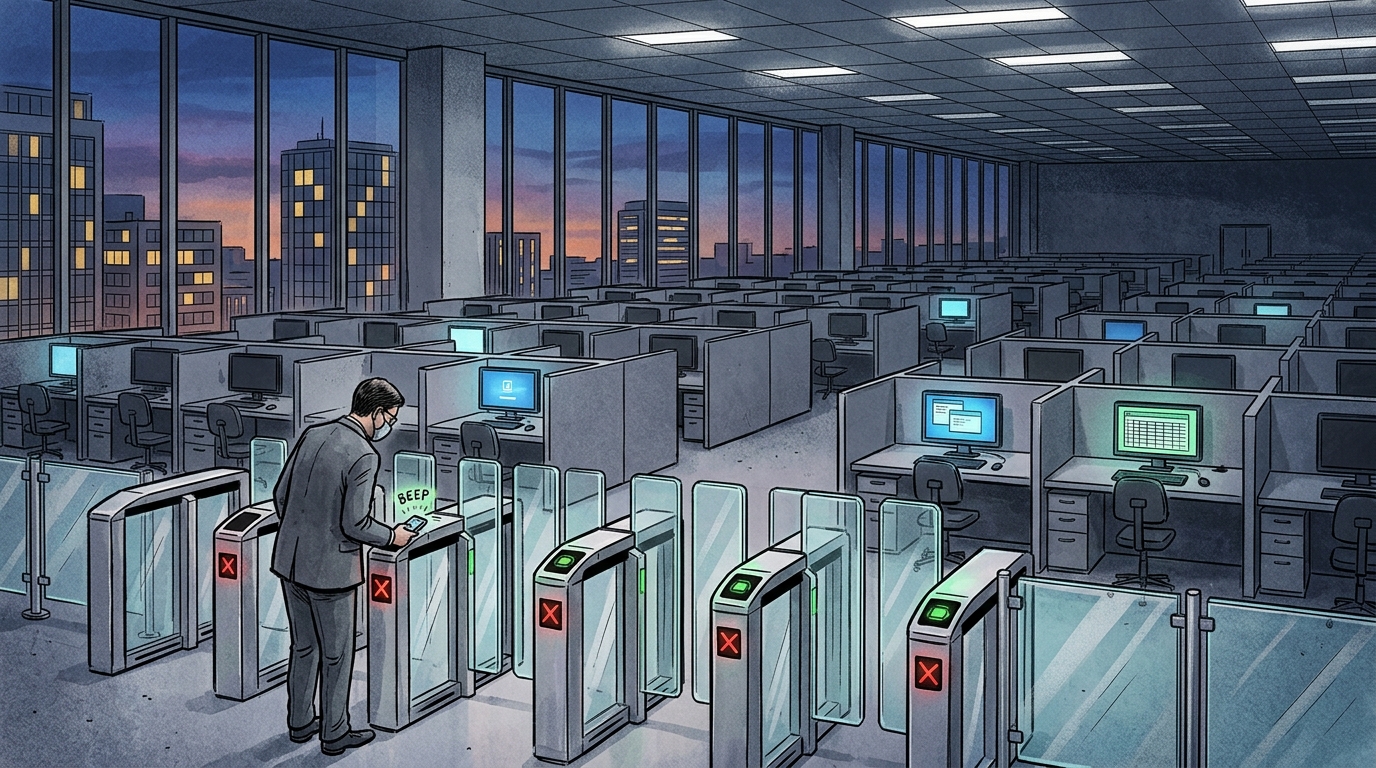
You badge in through the glass turnstile, where electronic sensors track your arrival timestamp down to the second. You walk through vast fluorescent bullpens past hundreds of employees sitting in deafening silence. Every single person is wearing large noise-canceling headphones, staring fixedly at a laptop screen, desperately trying to drown out the voice of their neighbor two desks over.
And what are they doing?
They are dialing into a Microsoft Teams or Zoom meeting with five colleagues who work in three completely different time zones.
The celebrated "in-person collaboration" consists of sitting under freezing air conditioning vents, eating an overpriced soggy sandwich out of a cardboard container, and messaging the person sitting six feet directly behind you on Slack: "Hey, can you review that pull request when you have a second?"
Physical presence has been severed from collaborative utility; it has been reduced purely to attendance verification. The turnstile badge swipe is the only metric that matters, logged into a dashboard that middle managers review every Friday to calculate compliance percentages.
Coercion Clothed in Community
In classical political philosophy, thinkers like Kautilya and Machiavelli often observed that rulers frequently utilize the vocabulary of moral unity to execute maneuvers of economic discipline. When an administration wishes to impose austerity or purge its ranks without inciting outright rebellion, it never frames the policy as financial distress; it frames it as a moral return to foundational virtue.
The modern corporate RTO campaign fits this archetype like a glove. It invokes "culture," "camaraderie," and "mentorship" to mask a simple operational lever: thinning the herd while maintaining the fiction that nobody was fired.
The tragedy is not simply the loss of flexible work; it is the destruction of professional trust. For several brief years, organizations operated on the radical premise that adults could be measured by the quality of what they produced rather than the number of hours their backs were visible to a roaming supervisor.
By trading that trust for attendance metrics and covert headcount reduction, corporate leadership may well have succeeded in cutting their wage bills. But they have also reminded an entire generation of workers of an old, unsparing truth: in the eyes of the corporate machine, you are never a collaborator; you are merely a line item waiting to be optimized.