The Streaming Paradox: How Peak TV Rebuilt the Cable Monster It Swore to Destroy
Satire / opinion, not factual reporting. AI-assisted, for curiosity, not authority.
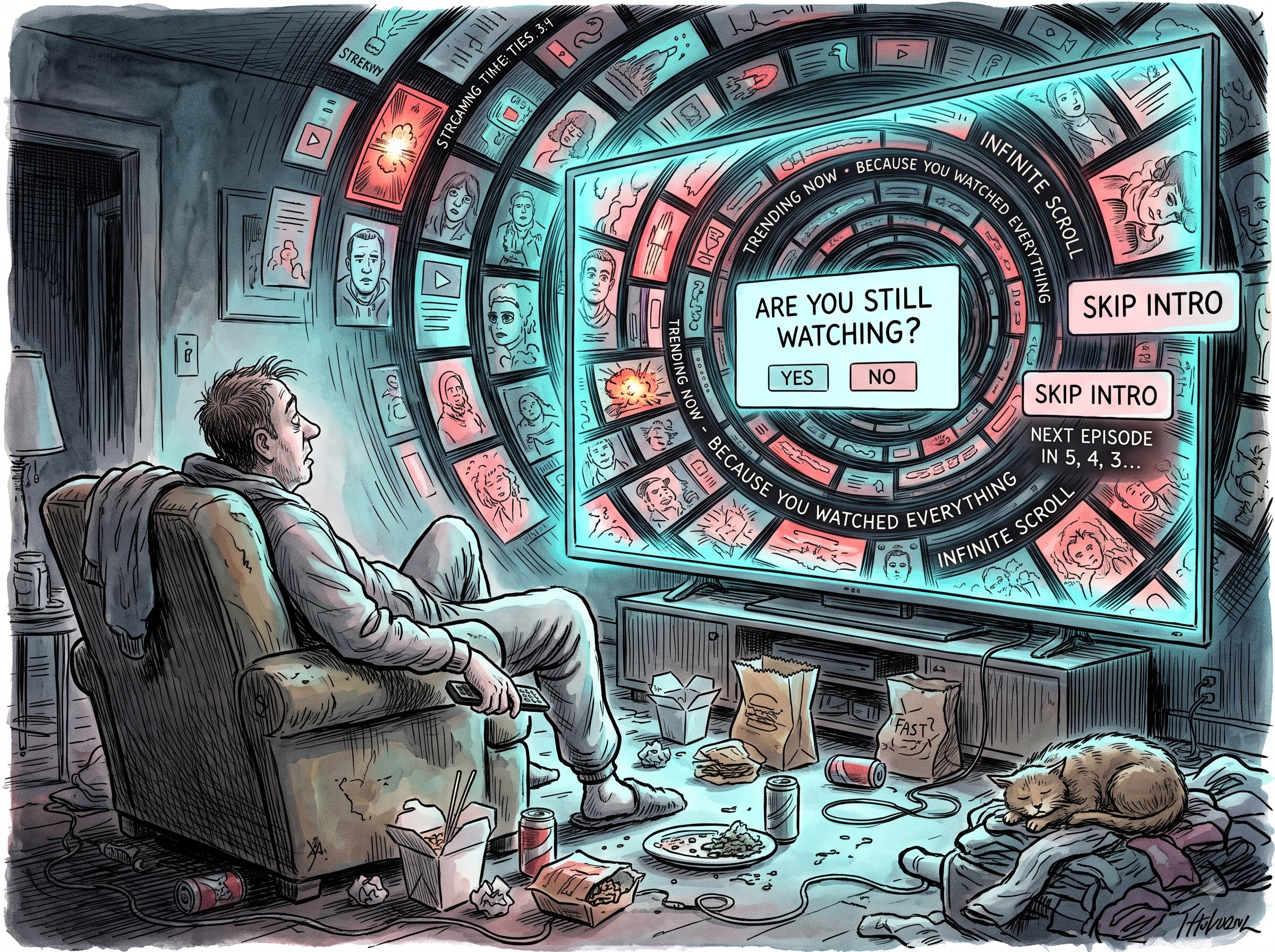
In the middle of the last decade, the world’s leading subscription streaming service published a five-word social media manifesto that felt, at the time, like the triumphant battle cry of a new digital golden age:
"Love is sharing a password."
It was a magnificent cultural gesture. For less than the price of two cinema tickets and a medium popcorn, you and your college roommate, your mother, your ex-partner, and a third cousin twice removed could feast on an infinite buffet of prestige cinema. No commercials. No weekly cliffhangers. No terrestrial broadcast schedules. You could watch an entire eight-hour psychological thriller in a single Saturday afternoon while wearing sweatpants and questioning your life choices.
Cable television—with its bloated hundred-dollar bundles, thirty minutes of unskippable pharmaceutical commercials per hour, and customer support lines that doubled as purgatory—was pronounced dead. Silicon Valley had disrupted Hollywood. The consumer had won.
Fast forward less than a decade, and that same utopian streaming landscape has transformed into a Kafkaesque comedy of corporate contradictions. The very platforms that once championed password sharing now track your household Wi-Fi IP address like an international border patrol. We have ad-supported subscription tiers. We have seasons arbitrarily chopped in half to trap you into two consecutive billing cycles. And we have arrived at the peak technological absurdity: being charged an extra surcharge simply to unlock 4K resolution on a 4K television you already paid for.
We did not kill cable. We merely rebuilt it, gave it a glowing app icon, and made you log in with a virtual keyboard using a faulty remote control.
The Algorithmic Slaughterhouse
The most baffling casualty of the streaming revolution has not been our wallets, but the art of storytelling itself.
In the old days of broadcast television, a network gave an eccentric, unconventional show two or three struggling seasons to find its voice, cultivate an audience, and develop cultural roots.
Under the algorithmic regime of modern streaming conglomerates, a show is treated less like art and more like a perishable dairy product. If a new, critically acclaimed series does not achieve hyper-viral global velocity within its first twenty-eight days of release—measured by an inscrutable corporate matrix of "completion rates" and "cost-per-view hours"—it is quietly dragged behind the server shed and shot.
Dozens of daring, inventive series with passionate followings are abandoned on permanent cliffhangers after season two, because the algorithm calculated that new subscribers don't join for season three. The result is a digital graveyard of unfinished narratives, making viewers increasingly reluctant to invest emotional energy into any new show in the first place. Why fall in love with a story when you know the termination notice is already being drafted in executive suites?
Meanwhile, the void is flooded with an endless, interchangeable sludge of cheap reality dating shows, generic true-crime docuseries where three episodes of content are stretched into nine, and algorithmic seasonal movies generated with all the creative soul of a microwave manual.
Layoffs in Ultra-High Definition
The internal corporate economics are no less surreal.
In recent years, as Wall Street's fever dream of "infinite subscriber growth" collided with the cold reality of a finite global population, the major entertainment tech conglomerates engaged in rounds of ruthless cost-cutting. Thousands of writers, animators, and engineers were dismissed via automated, two-minute group video calls.
There is something darkly fitting about being severed by an entertainment conglomerate that doesn't even have the corporate courtesy to throw in a complimentary lifetime subscription to the platform you helped build. Talented creators are cast out into the job market while executive compensation packages break nine figures and marketing budgets pour hundreds of millions into blockbuster action movies that audiences forget exist three days after release.
The Sisyphus of the Living Room
The ancient Greeks had the myth of Sisyphus—a man condemned by the gods to roll an immense boulder up a hill, only to watch it roll back down for all eternity.
The modern consumer has the home-screen catalog.
You sit down at 8:30 PM with dinner on your lap, intending to watch something entertaining. You scroll past Trending Now, skip Because You Watched A Murder Mystery, scroll through Critically Acclaimed Dramas, endure auto-playing previews that scream at you in high-definition surround sound, inspect forty-five different movie thumbnails (which the algorithm has dynamically altered to trick you into thinking it's a completely different film), and suddenly it is 9:15 PM. Your food is ice-cold, your enthusiasm is extinguished, and you end up re-watching an episode of a comfortable sitcom that was originally broadcast thirty years ago on the very network television you swore to abandon.
The philosopher Barry Schwartz called this the Paradox of Choice: an abundance of options does not make us freer; it paralyzes us. When you have ten thousand titles at your fingertips, the psychological cost of choosing the wrong one feels catastrophic.
Back to the Future
Today, if you want to watch the shows your friends are talking about, you must maintain active subscriptions across five different streaming platforms. You are paying upwards of a hundred dollars a month, enduring unskippable thirty-second ads for luxury cars you can't afford, and waiting a week between episodes for the season finale.
We spent fifteen years and billions of venture capital dollars dismantling the traditional cable bundle, only to recreate the exact same bundle in fragmented pieces that constantly log us out and demand two-factor authentication.
Streaming didn't liberate us from the television machine; it simply automated the billing cycle. But don't worry: if you stare at the screen long enough without moving, a familiar little dialogue box will still pop up in the dark to ask the ultimate philosophical question of our time:
"Are you still watching?"
No. We are just waiting for it to make sense again.