Ancient Vimanas: Texts vs Reality
The story
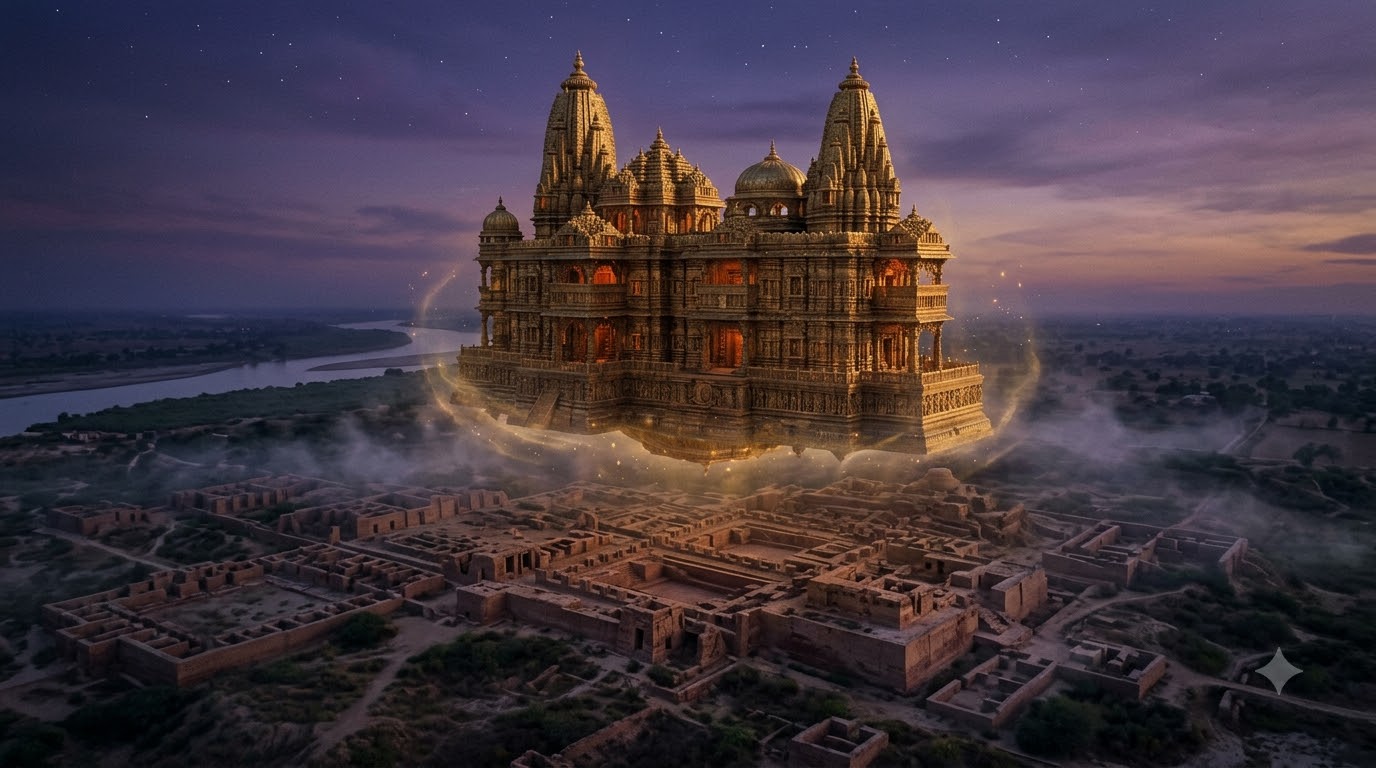
The concept of Vimanas—flying palaces or chariots—is deeply embedded in Hindu epics and texts. From the Pushpaka Vimana in the Ramayana, described as a celestial car that could fly anywhere at the will of its owner, to the intricate details found in later texts like the Vaimanika Shastra, these flying machines are portrayed with remarkable detail. Traditional retellings often describe them as powered by mysterious forces, moving silently through the sky, and even engaging in aerial combat.
What the evidence shows
From an archaeological and historical perspective, there is 🔴 Little to go on for physical flying machines in ancient India. While ancient texts vividly conceptualize flight, no physical remnants, blueprints, metallurgical engines, or archaeological artifacts matching these descriptions have ever been found in South Asian excavations.
The Vaimanika Shastra, a text often cited as evidence of ancient aviation, was revealed to be a 20th-century channeled work by Pandit Subbaraya Shastry, rather than an ancient scientific manual. An aeronautical study by the Indian Institute of Science in 1974 concluded that the flying machines described in the Vaimanika Shastra were aerodynamically unviable and incapable of flight. The concepts in older texts like the Vedas and Epics are generally interpreted by mainstream historians as poetic and mythological expressions of divine power and imagination, rather than literal technological descriptions.
Where experts disagree
Some proponents of ancient astronaut theories argue that the detailed descriptions of Vimanas in the epics, including their weapons and flight characteristics, suggest a forgotten high technology or extraterrestrial contact. They point to the specificity of the descriptions as being too advanced for mere imagination. However, the vast majority of historians, archaeologists, and aeronautical engineers disagree, stating that human imagination is entirely capable of conceptualizing flight long before technology makes it possible, much like Jules Verne conceptualized submarines and space travel.
What we still don't know
We still don't know the full extent of the technological metaphors used in ancient Sanskrit literature. While physical flying machines are highly improbable, the intricate descriptions may contain encoded allegories about consciousness, meditation, or lost philosophical concepts that we have yet to fully decode. The origins of the specific imagery used to describe these mythological vehicles remain an interesting subject for literary and psychological analysis.
Sources
- Deshpande, S. M., et al. "A Critical Study of the Work 'Vymanika Shastra'." Scientific Opinion, 1974.
- Bose, M. The Ramayana: A Modern Translation. Penguin Books, 2021.
Evidence Labels
More like this
The Submerged Stones of Dwarka: What Lies Beneath the Water?
Archaeologists found submerged stone walls and anchors off Dwarka. How much connects to the epic legend of Krishna’s sunken city?
How Did the Indus Valley Map the Stars 4,000 Years Ago?
Harappan cities were aligned to the cardinal directions long before magnetic compasses. What do street grids and steatite seals reveal about their astronomy?