Why Is Brahma Rarely Worshipped? Mythological Curses vs. Historical Shifts
The story
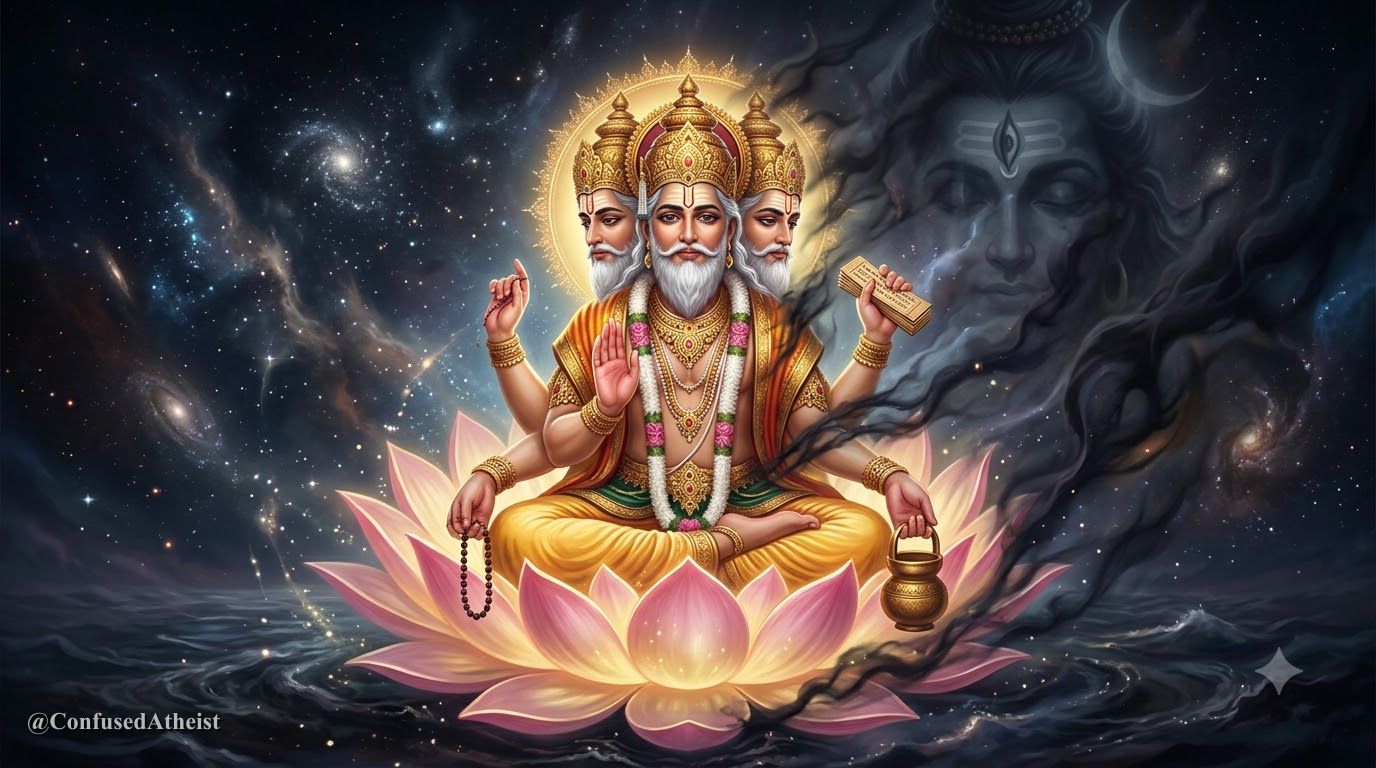
In classical Hindu cosmology, the Trimurti assigns cosmic creation (Srishti) to Brahma, preservation (Sthiti) to Vishnu, and dissolution/transformation (Laya) to Shiva. Yet a striking architectural paradox greets anyone traveling across the Indian subcontinent: while Shiva, Vishnu, and the Goddess (Shakti) are enshrined in hundreds of thousands of living temples, temples dedicated primarily to Brahma—most famously at Pushkar in Rajasthan, Asotra, and Kumbakonam—can be counted in a few dozen.
Puranic literature offers two dramatic mythological explanations for this absence:
- The Jyotirlinga Contest (Shiva Purana, Vidyeshvara Samhita 6–8): When Brahma and Vishnu debated who was supreme, Shiva manifested as an infinite column of fire (Lingodbhava). Vishnu assumed the form of a boar (Varaha), dug downward for ages, and honestly admitted he could not find the base. Brahma flew upward as a swan, caught a falling Ketaki flower, and falsely claimed he had witnessed the summit. For this falsehood, Shiva decreed that Brahma would lose his independent temple cult on Earth.
- The Curse of Savitri (Padma Purana, Srishti Khanda): During a great fire sacrifice at Pushkar, when Brahma's consort Savitri was delayed, Brahma hastily married the pastoral maiden Gayatri to complete the ritual on time—prompting a furious Savitri to curse him to be worshipped only in Pushkar.
What the evidence shows
That Prajapati/Brahma held a central position in Late Vedic ritual and early Buddhist/Jain dialogues before being eclipsed by Puranic Vaishnavism, Shaivism, and Shaktism is 🟢 Well-documented, while on the exact sociological causes of his cult's decline, 🟡 Scholars disagree.
- Prominence in the Brahmanas & Early Pali Canon: In the Shatapatha Brahmana and Brihadaranyaka Upanishad, Prajapati (later identified with Brahma) is the supreme lord of creation and sacrifice. Similarly, in the earliest Buddhist Pali Suttas (such as the Brahmajala Sutta and Tevijja Sutta, c. 5th–3rd century BCE), when the Buddha critiques orthodox Vedic religion, the highest deity invoked by Brahmins of that era is Maha-Brahma (Sahampati), not Vishnu or Shiva.
- The Rise of Bhakti & Soteriological Deities: Epigraphic and archaeological records from the 2nd century BCE through the Gupta Empire (4th–6th century CE) show royal patronage and popular Bhakti shifting overwhelmingly toward deities offering personal grace, heroic intervention, and liberation (Moksha)—namely Vasudeva-Vishnu, Shiva, and Durga.
- Southeast Asian & Iconographic Survival: While standalone Brahma shrines became rare in medieval India, Brahma remained prominently sculpted as a subsidiary directional deity on the northern outer walls (devakoshtha) of both Shaiva and Vaishnava temples, and enjoyed major royal cults in Cambodia (Angkor) and Java (Prambanan).
Where experts disagree
Historians of religion offer different models for why Brahma did not retain an independent devotional sect (Sampradaya).
Indologist Greg Bailey (The Mythology of Brahmā, 1983) argues that Brahma’s identity was structurally tied to Pravritti Dharma—the maintenance of worldly Vedic ritual order and social hierarchy—whereas post-Mauryan India became increasingly preoccupied with Nivritti Dharma (transcendence, liberation from rebirth, and emotional devotion), domains dominated by Vishnu and Shiva.
Conversely, historians such as R.N. Dandekar and Wendy Doniger read the Puranic curses in the Shiva Purana and Padma Purana as historical polemics recording sectarian competition, in which rising Shaiva and Vaishnava priesthoods absorbed the older Vedic creator into their own cosmologies (portraying Brahma as emerging from Vishnu's navel lotus).
What we still don't know
Because early timber and brick shrines from the 4th to 1st centuries BCE have not survived in the Gangetic plains, we still do not know how many standalone shrines to Prajapati or Brahma actually existed before the Gupta stone-temple boom, or whether his worship was always primarily liturgical (inside fire altars) rather than temple-based.
Sources
- Bailey, Greg. The Mythology of Brahmā. Oxford University Press, 1983.
- Shiva Purana, Vidyeshvara Samhita, Chapters 6–8 (The Legend of Lingodbhava).
- Rocher, Ludo. The Puranas. Otto Harrassowitz Verlag, 1986.
- Doniger, Wendy. The Hindus: An Alternative History. Penguin Books, 2009.
Evidence Labels
More like this
Giving Form to the Formless: How Vedic Rites Acquired Stone Deities
Tracing the transformation of ancient Indian worship from open-air abstract fire altars into sculpted temple murti traditions.
Did Ancient Myths Predict the Big Bang?
Exploring the parallels between the Big Bang theory and the ancient concept of the Cosmic Egg in Hindu cosmology.