Giving Form to the Formless: How Vedic Rites Acquired Stone Deities
The story
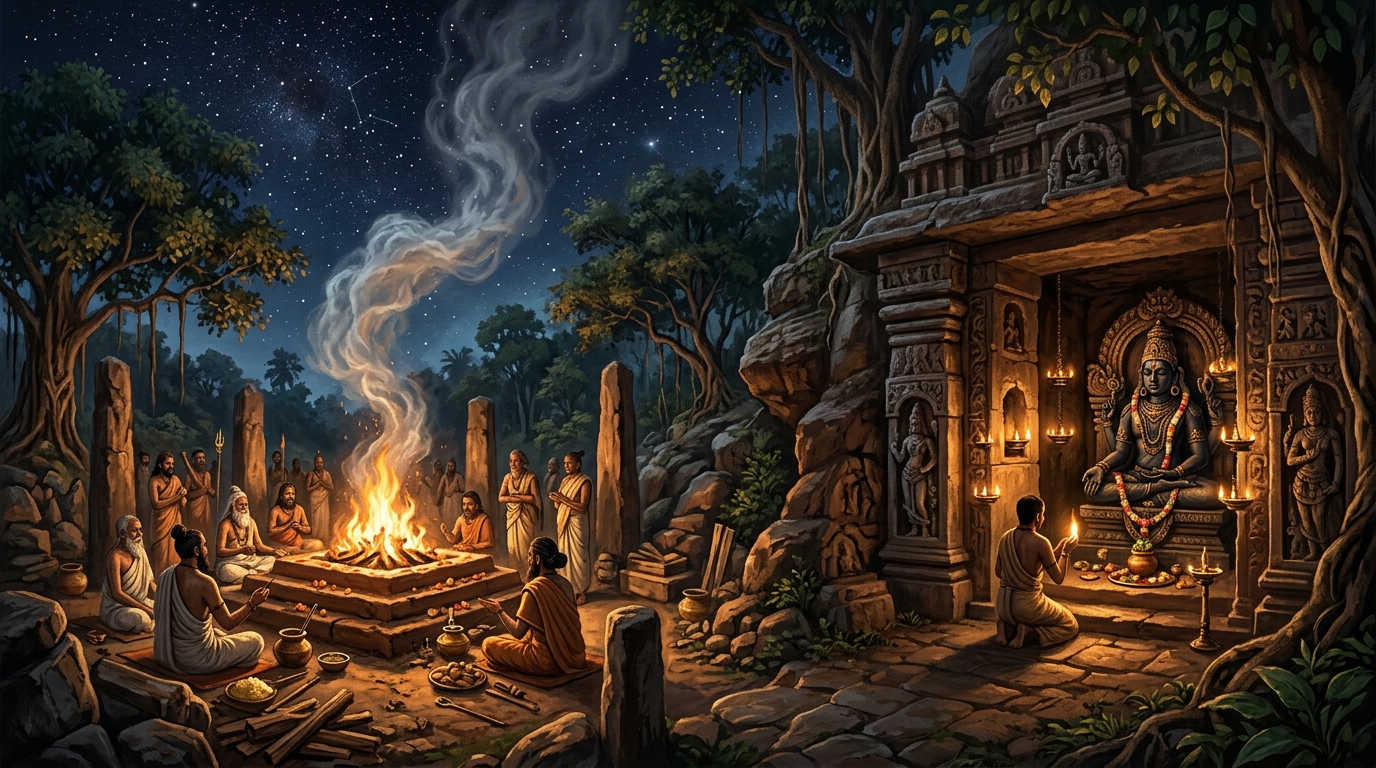
If a Vedic priest from 1200 BCE were transported into a monumental Hindu temple of the eighth century CE, they would likely find the surroundings unrecognizable.
In the earliest hymns of the Rigveda, sacred space was temporary and formless. There were no stone temples, no consecrated statues, and no permanent shrines. Worship centered on the yajna—an open-air sacrificial fire altar constructed out of measured bricks according to astronomical geometry, designed to be abandoned after the ritual concluded. The gods of that world—Agni (fire), Indra (thunder and rain), Varuna (cosmic order), and Soma (the sacred plant)—were elemental cosmic principles invited through chanted Sanskrit meter rather than carved physical likenesses.
Yet over the course of a thousand years, a profound metamorphosis occurred across the Indian subcontinent. The invisible, abstract cosmos acquired human faces, multiple arms, ornate jewelry, and monumental stone homes. The transitory fire ritual was largely eclipsed by puja—an intimate, enduring devotional interaction with an enshrined image (murti) that is ritually awakened, bathed, clothed, and addressed as a living sovereign presence.
How did an intellectual tradition that once proclaimed "There is no likeness of Him whose name is great glory" (Yajurveda 32.3) come to build the world's most sophisticated and intricate visual pantheon?
What the evidence shows
From an archaeological and historical perspective, why anthropomorphic stone deities emerged is where 🟡 Scholars disagree, though the material timeline is 🟢 Well-documented.
Excavations across northern and central India confirm that free-standing stone temples and carved stone deities do not appear in the archaeological record until the late centuries BCE:
- Absence in Early Strata: Neither the Harappan civilization (whose miniature steatite seals and terracotta figurines remain enigmatic) nor the Painted Grey Ware culture associated with the Vedic period has yielded monumental temples or identifiable stone icons.
- The Yaksha Precedents (3rd–2nd Century BCE): The earliest surviving monumental stone sculptures in India are colossal depictions of Yakshas and Yakshis (indigenous nature spirits and guardians of wealth and water), such as the Parkham Yaksha from Mathura and the Didarganj Yakshi. These figures demonstrate that stone craft was first used for popular earth spirits before being applied to Puranic deities.
- The Epigraphic Turning Point: The Heliodorus Pillar inscription at Besnagar (Madhya Pradesh), dated to approximately 113 BCE, records that a Greek ambassador named Heliodorus erected a stone garuda pillar in honor of Vasudeva (Krishna). This confirms that devotional cults centering on personal deities were already active and erecting public monuments by the 2nd century BCE.
- The Kushan and Gupta Explosion (1st–5th Century CE): Under the Kushan Empire in Mathura and Gandhara, we see the first widespread production of anthropomorphic stone figures of Shiva, Vishnu, Surya, and the Buddha. By the Gupta period (4th–6th century CE), free-standing stone sanctums—such as Temple 17 at Sanchi and the Dashavatara temple at Deogarh—established the architectural blueprint of the Hindu temple.
Where experts disagree
Historians and art historians disagree on the primary cultural engine that drove this transition.
One prominent academic school, led by art historian Ananda Coomaraswamy and social historian Romila Thapar, argues that anthropomorphic murti worship was largely a bottom-up adoption. Mainstream Vedic culture was originally an elite, textual, and non-iconic system practiced by priestly lineages. In contrast, non-Vedic, indigenous populations across the subcontinent had long worshipped localized nature spirits (Yakshas, Nagas, and village goddesses) through tangible sacred posts, terracotta figurines, and sacred trees. As the social base of Brahmanical religion expanded following the decline of the Mauryan Empire, the tradition assimilated these popular devotional practices to maintain cultural relevance, giving Vedic names to popular iconic forms.
A counter-perspective, favored by traditional theologians and epigraphers like V.S. Agrawala, contends that the iconography was an organic internal evolution. They point out that even the earliest Vedic hymns contain vivid poetic metaphors describing gods with golden arms, fiery hair, and radiant chariots. In this reading, the transition to stone sculptures was not an alien borrowing, but simply the translation of mental visualizations (dhyana mantras) into durable physical mediums as stoneworking technology matured under urbanization.
What we still don't know
We still do not have conclusive evidence explaining what perishable shrines existed before stone architecture became dominant. Because the climate of the Gangetic plains deteriorates wood, mudbrick, and thatch, centuries of early architectural development between 600 BCE and 200 BCE have vanished without leaving clear archaeological footprints.
We also do not know precisely when the complex philosophical defense of murti worship—which views the physical stone not as God, but as a consecrated lens (pratika) through which the infinite can be engaged—was first systematized in the early Agamas and Puranas.
Sources
- Thapar, Romila. Early India: From the Origins to AD 1300. University of California Press, 2004.
- Coomaraswamy, Ananda K. Yakṣas. Smithsonian Institution, 1928–1931.
- Singh, Upinder. A History of Ancient and Early Medieval India: From the Stone Age to the 12th Century. Pearson Longman, 2008.
- Jamison, Stephanie W., and Brereton, Joel P. The Rigveda: The Earliest Religious Poetry of India. Oxford University Press, 2014.
- Agrawala, V. S. Indian Art. Prithivi Prakashan, 1965.
Evidence Labels
More like this
The Sacred Geometry of Temples: How Stone Architecture Mapped the Cosmos
From the 64-square Vastu Purusha Mandala to self-similar fractal shikharas and musical pillars, how classical Indian temples encoded geometry in stone.
Vedic Mathematics: The Origins
Is Vedic Mathematics truly ancient and found in the Vedas?