Vedic Mathematics: The Origins
The story
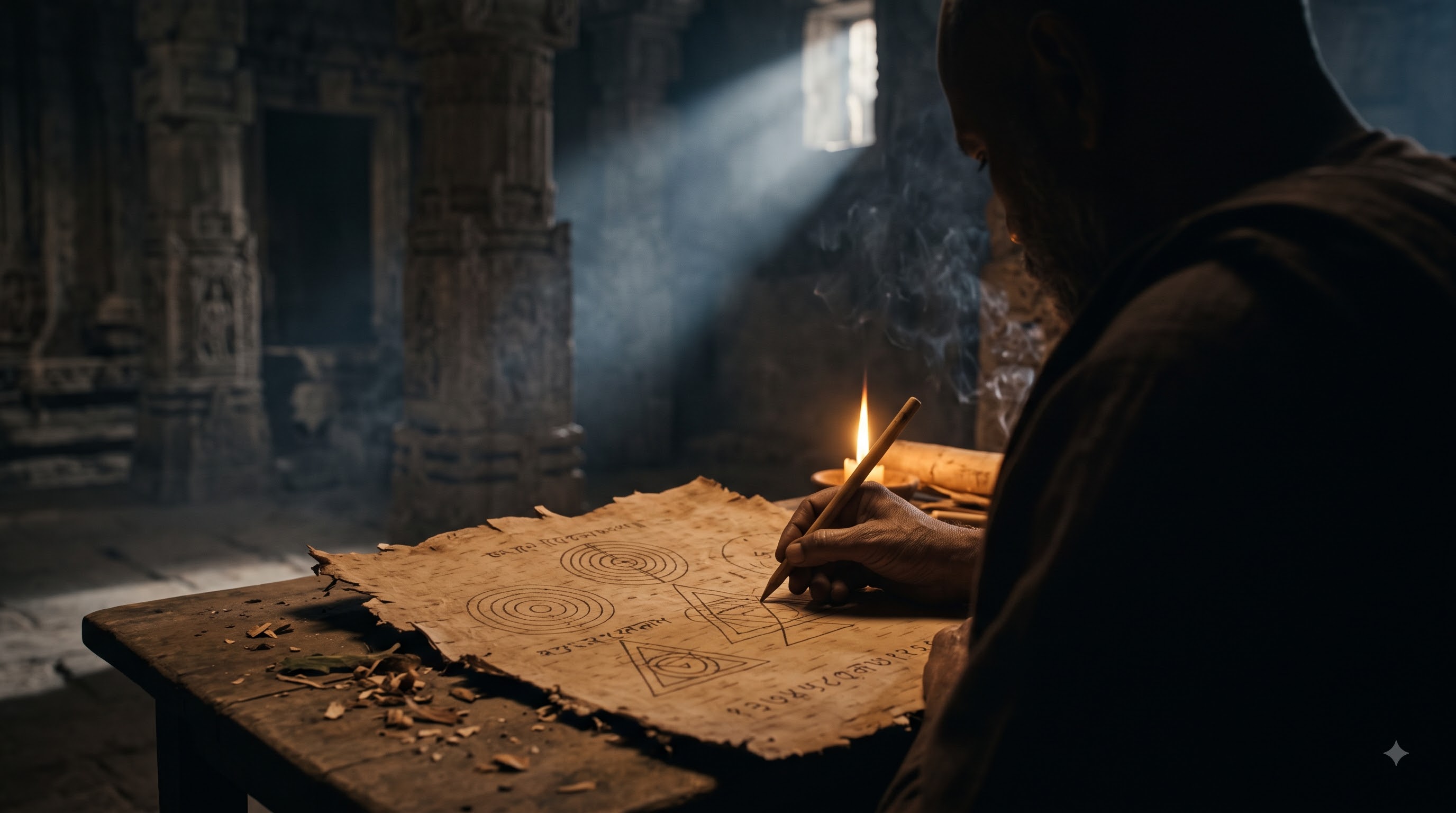
"Vedic Mathematics" is often presented as an ancient system of rapid mental calculation directly derived from the Vedas, the oldest sacred texts of Hinduism. Proponents claim that this system contains 16 sutras (aphorisms) that can solve complex arithmetic and algebraic problems with astonishing speed. It is frequently taught in schools and workshops as a testament to the advanced scientific and mathematical knowledge of ancient India.
What the evidence shows
The historical origin of what is now called "Vedic Mathematics" is a place where 🟡 Scholars disagree. The specific system popularized today was composed in the early 20th century by Swami Bharati Krishna Tirtha, the Shankaracharya of Govardhan Math, and published posthumously in 1965.
Historical evidence suggests that the 16 sutras are not explicitly found in the four standard Vedas (Rigveda, Yajurveda, Samaveda, Atharvaveda) or their known appendices (Parishishtas). The mathematical techniques presented by Tirtha are highly effective algebraic tricks, but they do not align with the known mathematical traditions of the Vedic period, which were primarily concerned with geometry for constructing fire altars (as seen in the Sulba Sutras).
Where experts disagree
The primary disagreement lies in the use of the term "Vedic." Most historians of mathematics assert that Tirtha's system is a modern invention, albeit a clever one, and labeling it "Vedic" is historically inaccurate. They argue that this misattribution obscures the genuine mathematical achievements of ancient India, such as the works of Aryabhata and Brahmagupta. Conversely, some traditional scholars argue that the sutras could have been derived from lost appendices of the Atharvaveda, or that Tirtha attained them through deep meditation and intuitive understanding of the Vedic corpus, making them "Vedic" in spirit if not in literal textual presence.
What we still don't know
We do not fully know the extent of the lost oral traditions and texts of ancient India. While Tirtha's specific 16 sutras appear to be a 20th-century compilation, it is possible they were inspired by older, unrecorded heuristic methods. We also continue to uncover new aspects of the genuinely ancient Sulba Sutras and Jain mathematical texts, which may yet reveal a more complex picture of early Indian mathematical pedagogy.
Sources
- Dani, S. G. "Myths and reality: On ‘Vedic mathematics’." Frontline, 1993.
- Plofker, Kim. Mathematics in India. Princeton University Press, 2009.
Evidence Labels
More like this
How Did the Indus Valley Map the Stars 4,000 Years Ago?
Harappan cities were aligned to the cardinal directions long before magnetic compasses. What do street grids and steatite seals reveal about their astronomy?
Did Ancient Myths Predict the Big Bang?
Exploring the parallels between the Big Bang theory and the ancient concept of the Cosmic Egg in Hindu cosmology.