The Sacred Geometry of Temples: How Stone Architecture Mapped the Cosmos
The story
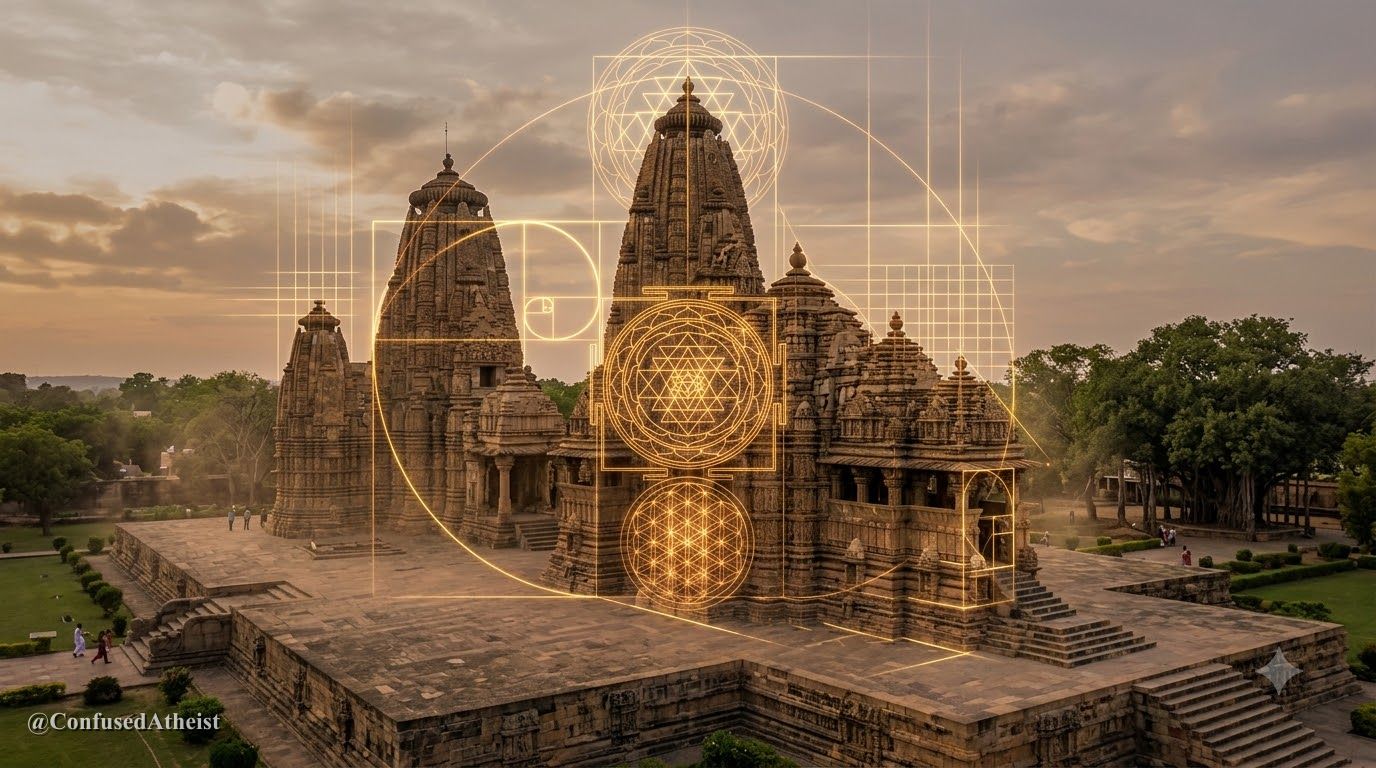
In classical Sanskrit architectural treatises—such as Brihat Samhita, Mayamata, Manasara, and Samaranganasutradhara—a Hindu temple (Prasada or Mandira) is never described merely as a congregational hall. Instead, it is conceived as a three-dimensional cosmological diagram in stone: a microcosm of the universe designed to align human space with astronomical cycles and geometric proportion.
What the evidence shows
The mathematical ground-plans, self-similar fractal superstructure (shikhara) geometry, and acoustic properties of medieval Indian temples are 🟢 Well-documented, while claims about supernatural energy vortexes or mystic radiation remain 🔴 Little to go on.
- The Vastu Purusha Mandala (64 & 81 Square Grids): As documented by art historian Stella Kramrisch and architectural surveys, temple foundations are laid out upon a strict proportional square grid (Manduka Mandala of $8 \times 8 = 64$ squares or Paramashayika Mandala of $9 \times 9 = 81$ squares). The innermost central squares (Brahmasthana) house the windowless sanctum (Garbhagriha or "womb-chamber"), while concentric outer rings govern wall thickness, circumambulatory paths (Pradakshina), and cardinal doorways aligned to the rising sun.
- Self-Similar Fractal Spires (Urusringas): In Northern (Nagara) temples such as the Kandariya Mahadeva at Khajuraho (c. 1030 CE) and Southern (Dravida) towers like the Brihadeeswarar Temple at Thanjavur (1010 CE), the main tower is constructed from dozens of miniature replicas of itself (urusringas or kutas) clustering and repeating across decreasing scales—an architectural realization of self-similar fractal geometry centuries before formal Western fractal notation.
- Lithophone Acoustic Pillars (Vittala Temple, Hampi): Ultrasonic and acoustic frequency analyses of the 56 Saregama granite colonnettes at the 16th-century Vijayanagara Vittala Temple in Hampi confirm that artisans varied the cross-sectional diameter, length, and hollow clustering of quartz-rich granite shafts so they resonate at distinct audible frequencies when tapped.
Where experts disagree
Architectural historians and physicists disagree on how much of the acoustic and solar behavior in temples was engineered via mathematical formulas versus empirical workshop craft.
Some researchers argue that the Shilpa Shastras encoded advanced wave physics and harmonic ratios specifically intended to entrain human brainwaves during mantra recitation. Conversely, architectural historians such as George Michell and Adam Hardy emphasize that master stonemason guilds (Sthapatis) worked through algorithmic modular proportions (tala and angula ratios) and generations of trial-and-error stone carving, rather than modern differential equations.
What we still don't know
Because the working palm-leaf sketchbooks and full-scale chalk templates (lanchhana) of medieval Sthapati guilds perished in the monsoon climate, we still do not know the exact mechanical hoists and earthen-ramp logistics used to lift 80-ton granite capstones (stupi) atop towers over 60 meters high at sites like Thanjavur.
Sources
- Kramrisch, Stella. The Hindu Temple (2 Vols.). University of Calcutta, 1946.
- Michell, George. The Hindu Temple: An Introduction to Its Meaning and Forms. University of Chicago Press, 1988.
- Hardy, Adam. The Temple Architecture of India. Wiley, 2007.
- Kumar, Anish, et al. "Comprehensive non-destructive characterization of musical pillars of Mahamandapam of Vitthala Temple at Hampi." Journal of Cultural Heritage, 2008.
Evidence Labels
More like this
Giving Form to the Formless: How Vedic Rites Acquired Stone Deities
Tracing the transformation of ancient Indian worship from open-air abstract fire altars into sculpted temple murti traditions.
Vedic Mathematics: The Origins
Is Vedic Mathematics truly ancient and found in the Vedas?