The Kurukshetra War: Day 13
The story
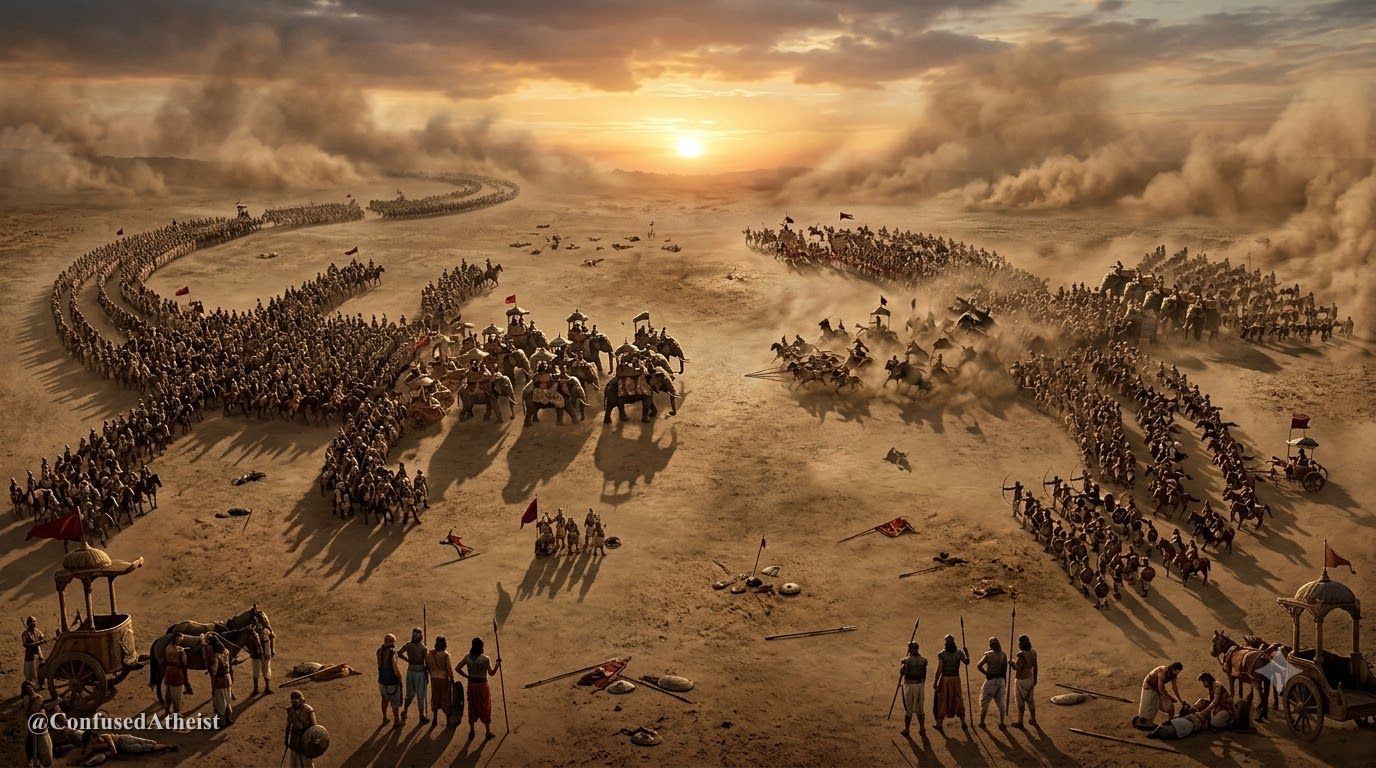
On the thirteenth day, Dronacharya organized the Kaurava army into the legendary Chakravyuha (Padmavyuha)—a rotating multi-layered circular maze of infantry, chariots, and elephants that moved like a cosmic whirlpool.
The strategy was designed around a deadly loophole: on the Pandava side, only Arjuna, Krishna, and Pradyumna knew the intricate secret of entering and exiting this labyrinth. With Arjuna once again lured away by the relentless Samsaptakas, the Pandava army faced certain destruction.
In this emergency, Yudhishthira turned to Arjuna's sixteen-year-old son, Abhimanyu. As a fetus in Subhadra's womb, Abhimanyu had overheard Arjuna explaining how to penetrate the outer circles of the maze, though Subhadra had fallen asleep before hearing how to escape. Confident that veteran elders would follow directly in his wake, Abhimanyu volunteered to break the formation.
The Isolation and the Fall
Abhimanyu pierced the Chakravyuha like a flash of lightning, slaughtering ranks of warriors and penetrating deep into the vortex. However, King Jayadratha of Sindhu—empowered by a boon granted by Shiva allowing him to hold back the Pandavas for one day—closed the breach behind him, isolating the young warrior completely from Yudhishthira, Bhima, and Satyaki.
Alone inside the labyrinth, Abhimanyu fought with extraordinary valor, defeating numerous senior commanders and slaying Lakshmana, the beloved son of Duryodhana.
Realizing the youth could not be bested in fair combat, six foremost Kaurava Maharathis—Drona, Kripa, Karna, Ashwatthama, Brihadbala, and Kritavarma—surrounded Abhimanyu simultaneously in blatant violation of the rules of single combat. Karna shattered his bow from behind, his chariot was dismantled, and his horses were killed. Defending himself with a broken chariot wheel, Abhimanyu fought until he was overwhelmed and struck down by the son of Dushasana.
What we still don't know
The slaughter of Abhimanyu is widely viewed as the moral turning point of the Kurukshetra War. It effectively terminated the chivalric codes of the Rigvedic tradition, establishing a grim precedent of reciprocity: having seen their youngest hero butchered by a committee of veterans, the Pandavas felt justified in discarding ethical constraints in subsequent encounters.
Sources
- Ganguli, K. M. (1883-1896). The Mahabharata of Krishna-Dwaipayana Vyasa (Drona Parva, Abhimanyu-badha Parva).
Evidence Labels
More like this
The Kurukshetra War: Day 12
The oath of the Samsaptakas. Bhagadatta unleashes the divine Vaishnavastra, intercepted by Krishna.
The Kurukshetra War: Day 14
Arjuna's vow of fire, the slaying of Jayadratha, and the ferocious midnight battle of Ghatotkacha.