The Kurukshetra War: Day 14
The story
When Arjuna returned to the camp and learned of his son Abhimanyu's brutal slaughter, his grief turned into incandescent rage. He swore a solemn vow: before the sun set on the fourteenth day, he would execute Jayadratha—the man who blocked the rescue—or cast himself into a blazing pyre.
Alerted to the vow, Drona devised a defensive formation kilometers deep (combining the Shakata, Padma, and Suchimukha Vyuhas) to conceal Jayadratha in the rear, guarded by the Kaurava elite.
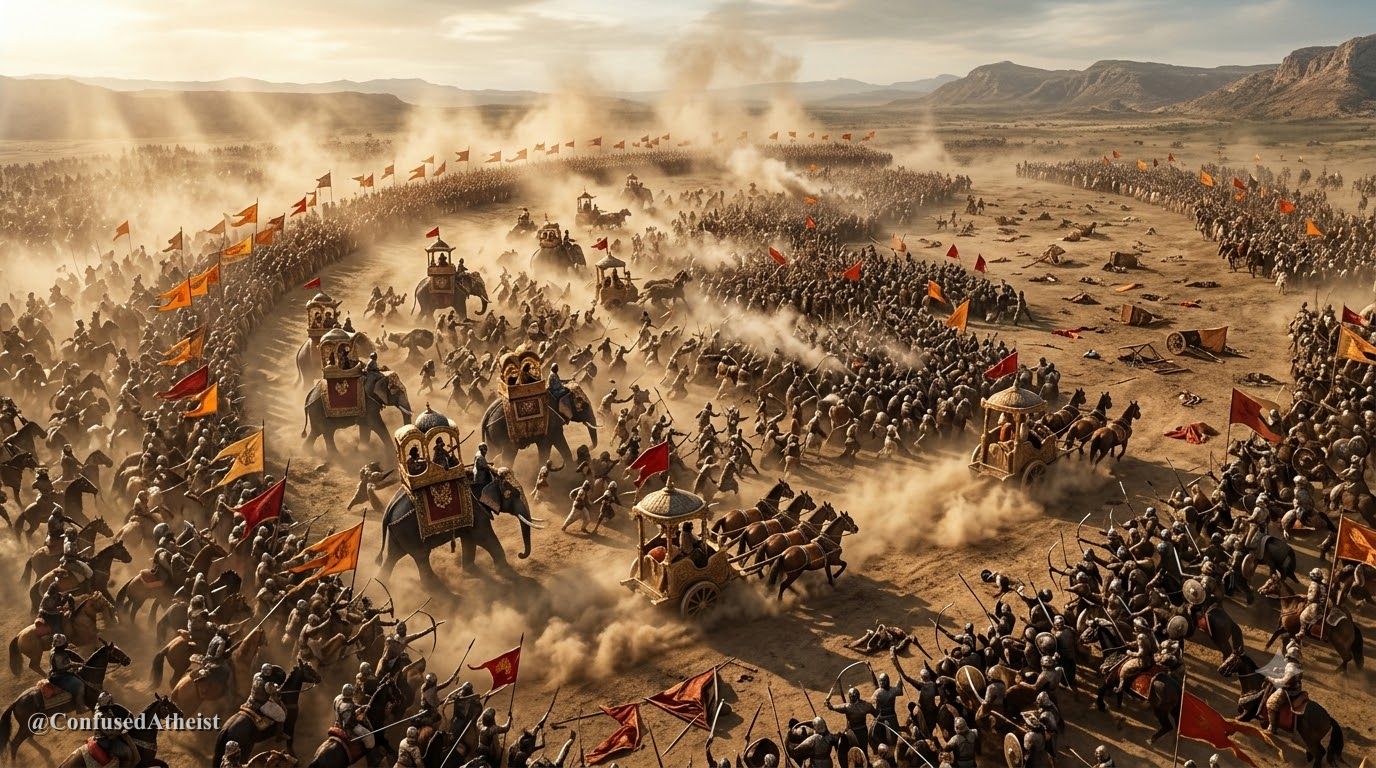
The Sunset Illusion and the Night Battle
Arjuna fought through endless divisions throughout the grueling day, yet as evening approached, Jayadratha remained out of reach. Krishna then employed his divine illusion (Maya), obscuring the sun with the Sudarshana Chakra to simulate dusk.
Believing the day was over and Arjuna was bound to burn himself alive, Jayadratha emerged to witness the spectacle. Immediately, Krishna dispelled the darkness, revealing the setting sun still above the horizon. With a single celestial arrow, Arjuna decapitated Jayadratha, guiding the severed head straight into the lap of Jayadratha's meditating father to neutralize an ancient curse.
Rather than ceasing hostilities at sundown, the fighting erupted into an unprecedented nocturnal war under the flare of thousands of torches. In the darkness, Bhima's Rakshasa son Ghatotkacha grew immensely powerful, conjuring terrifying illusions and crushing Kaurava divisions from the sky.
Driven to absolute panic, Duryodhana begged Karna to deploy the Vasava Shakti—an infallible divine dart gifted by Indra that could kill any target, but could only be used once. Karna had hoarded this weapon exclusively for Arjuna. Forced to choose between immediate annihilation and his long-cherished duel, Karna hurled the dart at Ghatotkacha. The giant fell dead, but Krishna celebrated: Arjuna was now free from the one weapon that could have ended his life.
What we still don't know
The fourteenth day represents total war in its rawest form. The transition to night fighting broke one of the most fundamental tenets of ancient Indian military conventions (Dharmayuddha), prefiguring the total breakdown of societal order depicted in the final stages of the epic.
Sources
- Ganguli, K. M. (1883-1896). The Mahabharata of Krishna-Dwaipayana Vyasa (Drona Parva, Jayadratha-badha Parva & Ghatotkacha-badha Parva).
Evidence Labels
More like this
The Kurukshetra War: Day 13
The tragedy of the Chakravyuha. Sixteen-year-old Abhimanyu breaches the spiral maze, fighting to the last breath.
The Kurukshetra War: Day 15
'Ashwatthama is dead.' The moral collapse of Yudhishthira and the fall of Preceptor Drona.