The Kurukshetra War: Day 15
The story
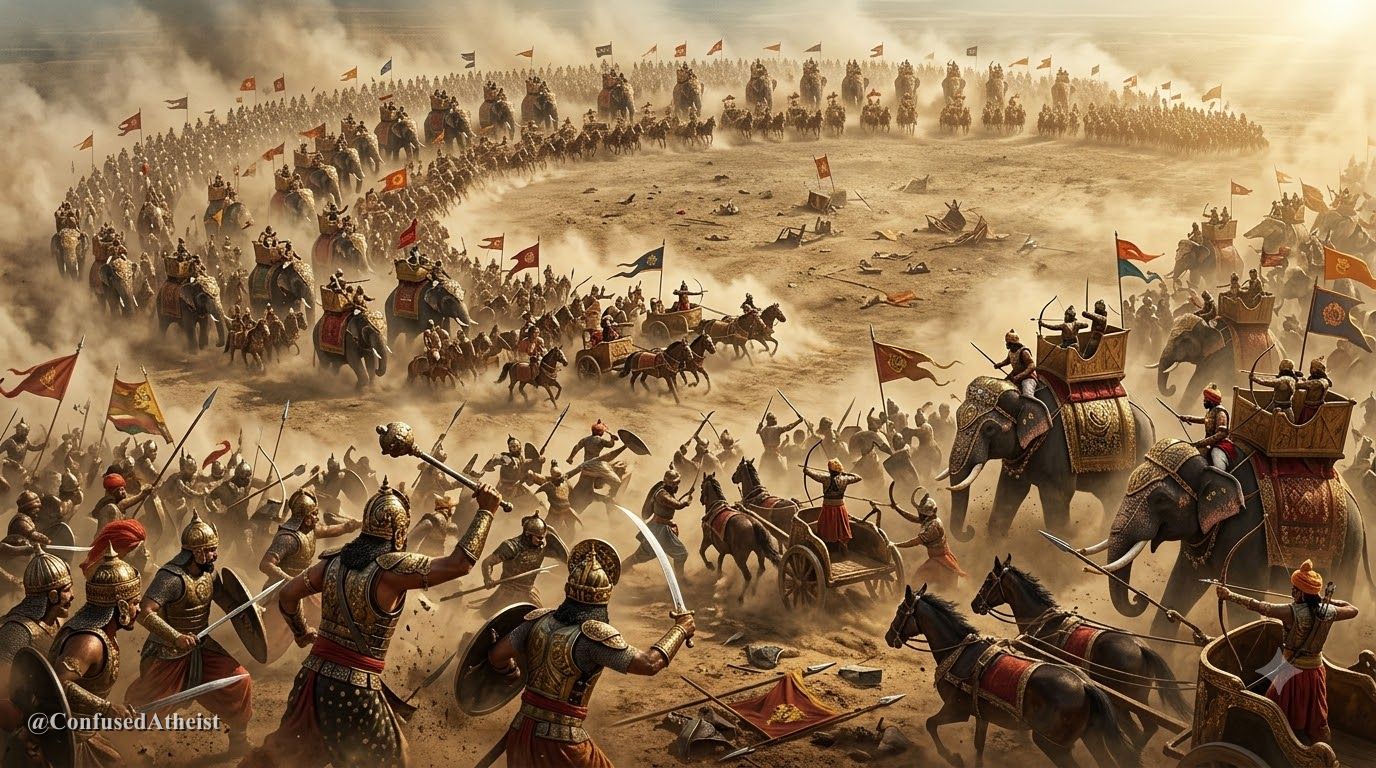
On the fifteenth morning, Dronacharya fought with unrestrained fury. Heartbroken by the deaths of comrades and enraged by the continuous slaughter, the master unleashed devastating celestial weapons, including the Brahmastra, decimating thousands of common soldiers.
Seeing the Pandava army on the verge of extinction, Krishna realized Drona could never be defeated by direct force of arms. He could only be stopped if he laid down his weapons voluntarily—something he would do only upon hearing of the death of his beloved son, Ashwatthama.
The Half-Truth and the Sinking Chariot
Bhima slew a massive war elephant belonging to the Malava kingdom, which happened to be named Ashwatthama. Bhima then shouted across the lines that Ashwatthama was dead. Drona was shaken, but refused to believe anyone except Yudhishthira, whose reputation for absolute truthfulness was renowned across the three realms.
Under intense pressure from Krishna to prevent the annihilation of his army, Yudhishthira uttered the famous conditional phrase: "Ashwatthama hathah... iti narova kunjarova" ("Ashwatthama is dead... whether man or elephant"). As he spoke the qualifying words, Krishna and the warriors blew their conches with deafening noise, drowning out the clarification.
According to the text, Yudhishthira's chariot had previously always floated four finger-widths above the ground due to his pure righteousness. At the moment he uttered this deception, his wheels sank into the mud and touched the common dust of the earth.
Devastated by grief, Drona discarded his weapons, sat down in the lotus posture upon his chariot, and entered deep meditation, dispatching his soul upward. While the guru was absorbed in yogic trance, Dhrishtadyumna charged forward and severed Drona's head, fulfilling the purpose for which he had been born from the sacrificial fire.
What we still don't know
The fall of Drona is often cited as the deepest moral paradox in ancient literature. It forces the audience to confront utilitarian ethics: can a noble lie be justified to stop a devastating slaughter, and what is the irrevocable cost to the soul of the one who speaks it?
Sources
- Ganguli, K. M. (1883-1896). The Mahabharata of Krishna-Dwaipayana Vyasa (Drona Parva, Drona-badha Parva).
Evidence Labels
More like this
The Kurukshetra War: Day 14
Arjuna's vow of fire, the slaying of Jayadratha, and the ferocious midnight battle of Ghatotkacha.
The Kurukshetra War: Day 16
Karna takes supreme command. Bhima confronts Dusshasana and fulfills the blood oath of the dice hall.