The Kurukshetra War: Day 3
Day 3: The Eagle Formation and Krishna's Vow
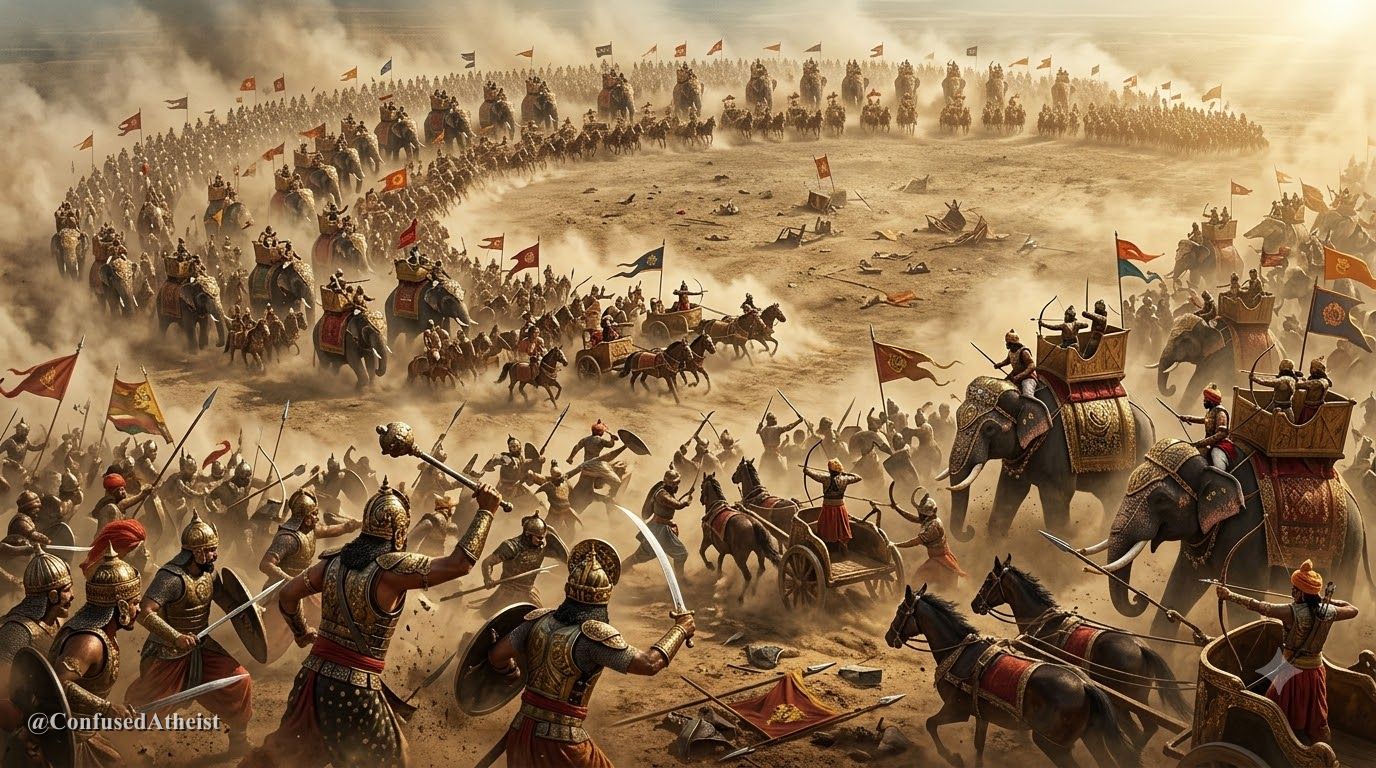
Day 3 witnessed shifting fortunes, terrifying celestial weapons, and a moment that nearly broke a divine promise.
The Formations
Bhishma arranged the Kaurava forces in the Garuda Vyaha (Eagle formation), a highly mobile and aggressive setup. The Pandavas formed the Ardha Chandra Vyaha (Half-moon formation) to envelop and crush the eagle's wings.
The Battle
The morning favored the Kauravas. Duryodhana, emboldened, unleashed a devastating attack on the Pandava flanks. However, the Pandavas retaliated fiercely. Ghatotkacha, the half-demon son of Bhima, used his illusions to create chaos among the Kaurava ranks, forcing them to scatter.
As the day progressed, Bhishma rallied his troops and unleashed a terrifying assault on Arjuna. Arjuna, perhaps subconsciously holding back against his beloved grandfather, struggled to counter Bhishma's divine astras.
The Broken Vow
Seeing Arjuna overwhelmed and the Pandava army being slaughtered, Krishna's patience snapped. He had vowed not to lift a weapon in the war, but in a moment of supreme divine fury, he dropped the reins of the chariot, picked up a discarded chariot wheel (serving as his Sudarshana Chakra), and charged at Bhishma.
Arjuna desperately chased after Krishna, grabbing his feet to stop him, pleading that he would fight with all his might. Appeased, Krishna returned to the chariot. This moment served as a stark reminder of the stakes and forced Arjuna to abandon his hesitations.
Sources
- Buitenen, J. A. B. van (Trans.). The Mahabharata, Volume 4: The Book of Bhishma. University of Chicago Press, 1981.
- Sukthankar, V. S., et al. The Mahabharata: Critical Edition. Bhandarkar Oriental Research Institute, 1933–1966.