The Kurukshetra War: Day 4
Day 4: Bhima's Fury and the Heavy Toll of Vengeance
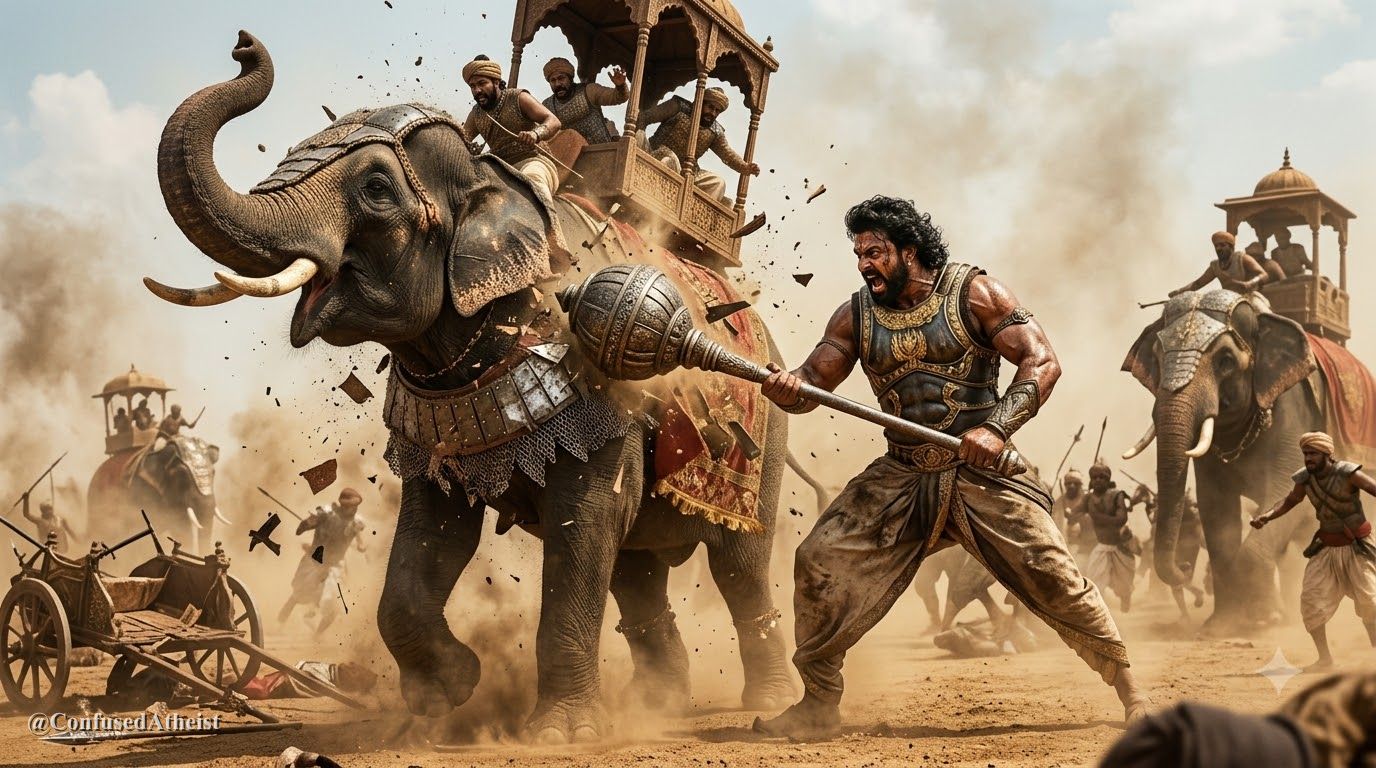
The fourth day of the Kurukshetra war was not just a clash of weapons; it was a brutal unveiling of the deep-seated anger that had festered for over a decade. It was the day the war stopped being about a kingdom and became terrifyingly personal.
The Formations
The Kauravas arranged their troops in the Makara Vyaha (Crocodile formation), a defensive yet aggressive posture. The Pandavas, looking to break through, adopted the Shyena Vyaha (Hawk formation), designed to swoop down and penetrate the enemy lines rapidly. But formations mean little when raw emotion takes the reins.
The Weight of a Vow
The spotlight of the fourth day fell squarely on Bhima. For years, the humiliation of his wife, Draupadi, at the hands of the Kauravas had burned within him. When he stepped onto the battlefield wielding his massive mace, it wasn't just a weapon—it was an instrument of his long-suppressed grief and fury.
He tore through the Kaurava ranks with terrifying strength, his roars echoing across the plains. But the true tragedy unfolded when he encountered the sons of Dhritarashtra. Fulfilling a dreadful vow made during the fateful game of dice, Bhima slew eight of Duryodhana's brothers in fierce combat.
While history remembers this as a feat of strength, the human cost was immeasurable. For Bhima, the act of killing his own cousins—men he had played with as a child—was a heavy burden cloaked in righteous anger. For Duryodhana, watching his brothers fall one by one was a shattering blow that brought the reality of his own hubris crashing down around him. It was a stark reminder that in war, even the victor loses a part of their soul.
The Aftermath
By the end of the day, the Kaurava camp was shrouded in an eerie, devastating silence. The wails of grief replaced the war drums. Bhishma, despite his unmatched skill, could not shield his grand-nephews from their karmic fate. The psychological advantage had swung back to the Pandavas, but as Bhima sat in his tent that night, surrounded by the blood of his kin, the silence of the battlefield offered no real peace—only the grim realization of what was yet to come.
Sources
- Buitenen, J. A. B. van (Trans.). The Mahabharata, Volume 4: The Book of Bhishma. University of Chicago Press, 1981.
- Sukthankar, V. S., et al. The Mahabharata: Critical Edition. Bhandarkar Oriental Research Institute, 1933–1966.