The Kurukshetra War: Day 5
Day 5: The Exhaustion of Attrition and the Rise of Satyaki
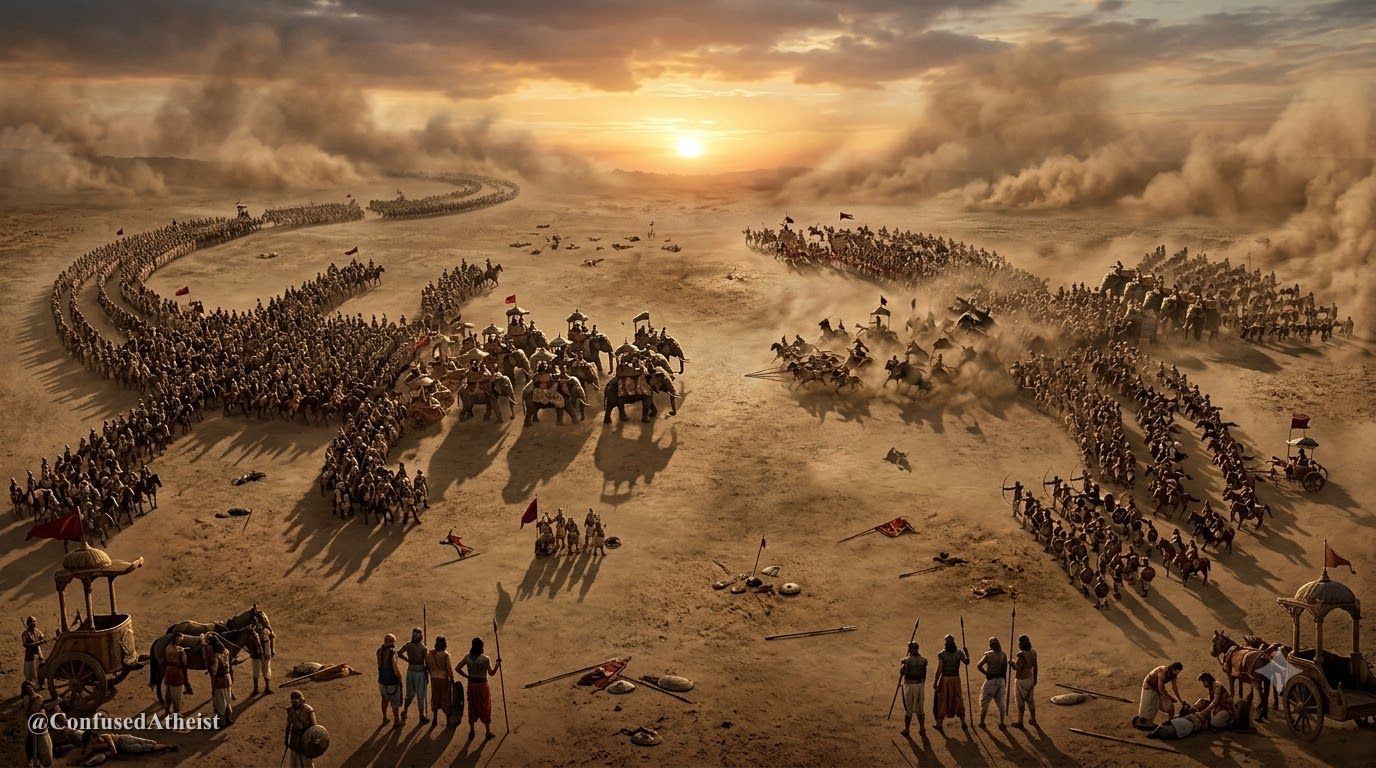
By the fifth day of the Kurukshetra war, the initial adrenaline of battle had faded, replaced by a grim, bone-deep exhaustion. The realization that this would not be a swift victory settled heavily on both camps. It was a day that tested not just physical endurance, but the emotional resilience of every soldier on the field.
The Formations
Bhishma, burdened by the previous day's losses but bound by duty, arranged the Kaurava forces in the massive Makara Vyaha (Crocodile formation) once again. The Pandavas, sensing the Kauravas' desperation, countered with the Shyena Vyaha (Hawk formation). The strategy was repetitive, mirroring the creeping monotony of the slaughter.
The Bitter Duels
The day was characterized by numerous one-on-one combats between prominent warriors who had known each other for a lifetime. Arjuna and Bhishma clashed once more. As their arrows darkened the sky, one could sense the unspoken tragedy—a grandfather and his beloved grandson locked in a deadly dance, both fulfilling their dharma, both deeply conflicted, neither able to strike the fatal blow.
Amidst this heavy atmosphere, the day's highlight belonged to Satyaki, the valiant Yadava warrior fighting for the Pandavas, and Bhurishravas, a formidable Kaurava ally. Their duel was not just a clash of steel, but a desperate struggle for relevance in a war overshadowed by demigods. Satyaki fought with a frantic, relentless energy, pushing himself beyond human limits. His prowess on this day firmly established him as one of the elite warriors, but the desperate look in the eyes of fighting men betrayed the cost of such glory.
The Aftermath
As the sun set, casting long, bloody shadows across the plains of Kurukshetra, both armies retreated to their camps. The death toll was staggering. The fifth day did not bring a clear victory, but it brought a crushing clarity: this war was becoming a grinding machine of attrition. In the tents that night, there were fewer cheers and more silent prayers, as warriors on both sides grappled with the horrifying realization that the only way forward was through more bloodshed.
Sources
- Buitenen, J. A. B. van (Trans.). The Mahabharata, Volume 4: The Book of Bhishma. University of Chicago Press, 1981.
- Sukthankar, V. S., et al. The Mahabharata: Critical Edition. Bhandarkar Oriental Research Institute, 1933–1966.