Navratri Day 4: Maa Kushmanda & Adi Shakti, the Primordial Smile that Ignited Creation
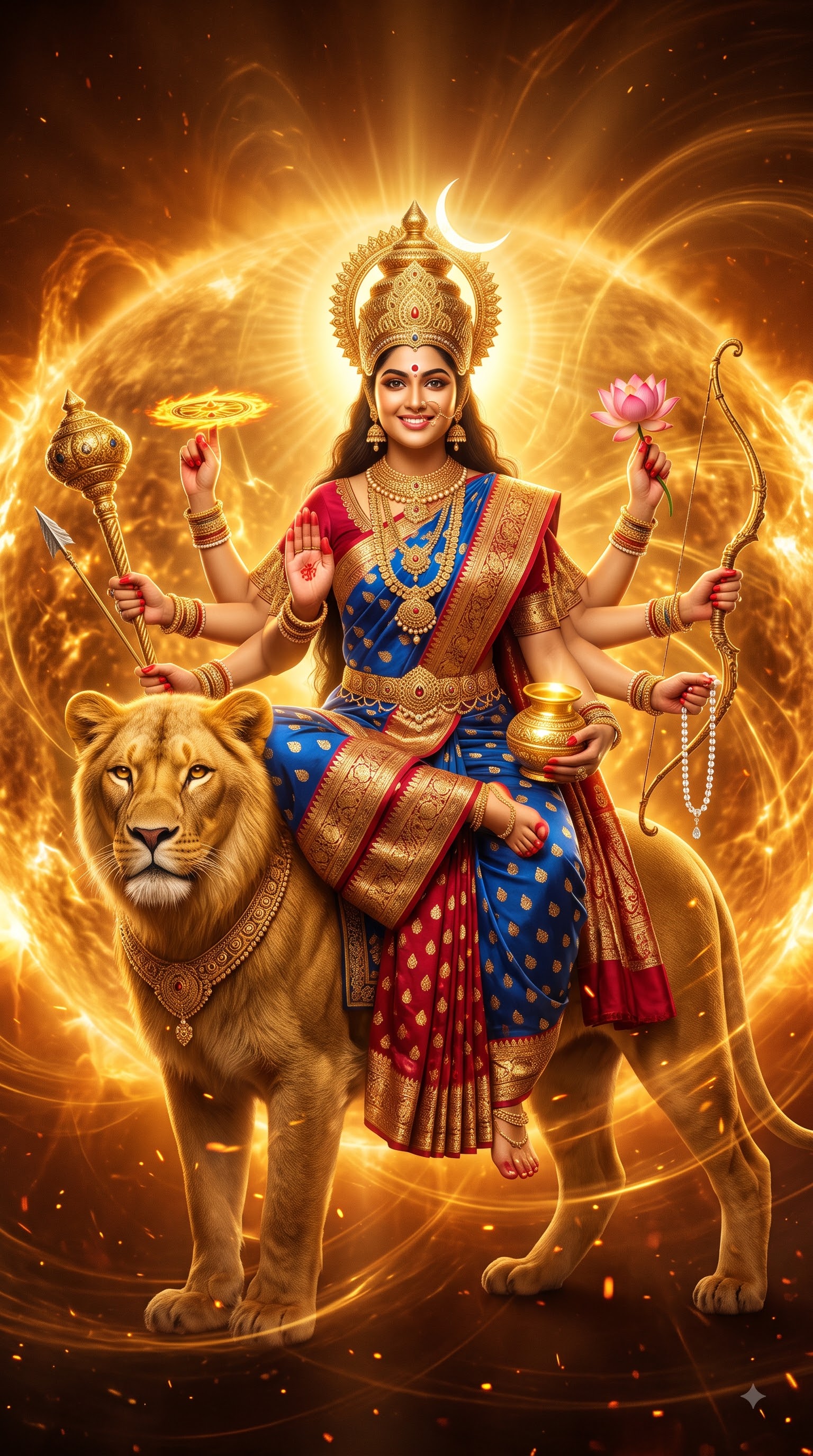
On the fourth night of Navratri (Chaturthi), Shakta philosophy turns its gaze from earthly penance toward cosmic genesis. Maa Kushmanda is venerated as the primordial solar demiurge—the uncaused First Cause whose gentle, radiant smile dissolved the eternal void and breathed light, motion, and warmth into the cosmic egg (Brahmanda).
Traditional liturgical calendars associate her day with vibrant Royal Blue—representing the unfathomable depth of the primordial cosmic void—and luminous Solar Orange, reflecting the warmth that sustains biological life.
The story
The Void and the Primordial Smile
According to the Devi Bhagavata Purana and Shakta cosmological traditions, before the formation of stars, planets, gods, or mortals, there existed only Andhakara—an absolute, silent, pitch-black void. There was no space, no time, and no matter; existence rested in inert equilibrium.
Within this unfathomable emptiness, a spark of supreme consciousness (Para Shakti) stirred. Manifesting as an effulgent divine form, she smiled softly (Ihat Hasya).
That single, effortless smile released an infinite flash of cosmic energy. The cosmic egg (Brahmanda) was illuminated from within, setting the dormant elements of creation into perpetual spin.
The name Kushmanda mathematically encodes this cosmic act:
- Ku (कु): Small or subtle.
- Ushma (ऊष्मा): Warmth, heat, or cosmic energy.
- Anda (अण्ड): The cosmic egg or universe.
She is therefore the supreme entity who, through a minute fraction of her primordial warmth, birthed and animated the macrocosm.
The Source of the Trinity
In Puranic and Tantric cosmogony, Maa Kushmanda is not merely a warrior manifestation; she is the mother of the cosmos (Jagadjanani). Before bringing the physical universe into material manifestation, she generated the primary cosmic archetypes from her three divine eyes:
- From her left eye: She manifested Mahakali, the embodiment of time, dissolution, and transformation.
- From her third eye: She manifested Mahalakshmi, the supreme force of sustenance, light, and prosperity.
- From her right eye: She manifested Mahasaraswati, the cosmic intelligence, wisdom, and creative sound.
From these three primordial goddesses, the Holy Trinity was brought forth: Mahakali brought forth Shiva and Saraswati; Mahalakshmi brought forth Brahma and Lakshmi; and Mahasaraswati brought forth Vishnu and Kali (or Gauri). Through their divine unions, the responsibilities of continuous creation, preservation, and dissolution were set in motion across the eons.
Residing Within the Surya Mandala
In Shakta Tantras and Agama scriptures, Maa Kushmanda is identified as the singular conscious power dwelling within the Surya Mandala—the nuclear furnace at the very core of the Sun.
Scriptures state that no mortal, god, or celestial being possesses the spiritual or physical capacity to survive the cataclysmic heat of the solar interior. Maa Kushmanda alone abides there, acting as the internal engine of solar radiation. The blinding brilliance of the sun, which illuminates and feeds every planetary ecosystem in our solar system, is described as merely a faint exterior reflection of her inner radiance.
Ashtabhuja: The Geometry of Eight Arms
Iconographically, Maa Kushmanda is portrayed as Ashtabhuja (eight-armed), mounted upon a fierce lioness. Each arm holds an emblem representing cosmic governance:
- Kamandalu (Water Vessel): Symbolizing the primal waters of creation and ascetic discipline.
- Dhanush (Bow): Representing potential energy and concentrated willpower.
- Bana (Arrow): Symbolizing kinetic motion, purposeful direction, and the speed of light.
- Padma (Lotus): The unfolding of spiritual consciousness untouched by worldly decay.
- Gada (Mace): The power of cosmic order (Rta) and the destruction of inert delusion.
- Chakra (Discus): The relentless, cyclical wheel of cosmic time (Kala).
- Amrit Kalash (Jar of Elixir): The celestial pitcher containing Prana (vital life-force) and immortality, demonstrating her role as the sustainer of life.
- Japamala (Rosary): An eight-bead rosary containing the seed vibrations of all Eight Siddhis (spiritual perfections) and Nine Nidhis (divine treasures).
Nirguna and Saguna: The Cosmic Form
Shakta metaphysics describes the Goddess in two essential aspects:
- Nirguna Swarupa (Formless Absolute): Pure, unmanifest light beyond space, time, and physical features.
- Saguna Swarupa (Embodied Form): When manifesting before the Trimurti, she appears as a majestic queen shining with the effulgence of ten million suns (Koti Surya). Her skin radiates a molten gold and fire-hued glow. She is clad in royal crimson and brilliant blue garments, her brow crowned by a gleaming crescent moon (Ardharatri). In the Devi Bhagavata Purana, her cosmic form (Virat Roop) spans the universe: the galaxies and nebulae are her flowing tresses, the sun and moon are her eyes, and the infinite directions are her ears.
Sacred Verses and Chants
Devotees recite the ancient Dhyana Shloka from the Devi Mahatmya to invoke her purifying energy:
सुरासम्पूर्णकलशं रुधिराप्लुतमेव च।
दधाना हस्तपद्माभ्यां कूष्माण्डा शुभदास्तु मे॥

Transliteration:
Surā-sampūrṇa-kalaśaṁ rudhirāplutam-eva ca |
Dadhānā hasta-padmābhyāṁ kūṣmāṇḍā śubhadāstu me ||

Translation:
Holding in her lotus hands sacred jars brimming with revitalizing nectar and the cosmic life-stream, may the auspicious Goddess Kushmanda bestow health, radiant vitality, and blessings upon me.
In the Narayani Stuti (Durga Saptashati), her triple cosmic functions of creation, preservation, and dissolution are honored:
सृष्टिस्थितिविनाशानां शक्तिभूते सनातनि ।
गुणाश्रये गुणमये नारायणि नमोऽस्तु ते ॥

Translation:
O Eternal Goddess, the living embodiment of creation, preservation, and dissolution! You are the shelter and substance of the three cosmic qualities (Sattva, Rajas, Tamas). Salutations unto you, O Narayani!
Her primary meditative invocation and primordial Beej Mantra:
नमो देव्यै महादेव्यै शिवायै सततं नमः ।
नमः प्रकृत्यै भद्रायै नियताः प्रणताः स्म ताम् ॥

Beej Mantra:
ॐ ऐं ह्रीं क्लीं चामुण्डायै विच्चे ॥
What the evidence shows
The Hiranyagarbha Connection and Vedic Roots
While the proper name "Kushmanda" does not appear as a personified deity in the four primary Samhitas (Rig, Sama, Yajur, Atharva), comparative historians observe that her foundational concept directly maps onto early Vedic cosmogony:
- Hiranyagarbha (The Golden Womb): In Rigveda 10.121, the universe originates from Hiranyagarbha—a golden egg or womb that floated upon the dark primordial waters before creation. Puranic theologians integrated this Vedic concept directly into Kushmanda, whose very name (Anda) designates her as the animator of this primordial egg.
- The Kushmanda Sukta of the Taittiriya Aranyaka: In the Taittiriya Aranyaka of the Black Yajurveda (Book 2), explicit liturgical verses known as the Kushmanda Mantras are prescribed for internal purification, spiritual confession, and the cleansing of past karmic transgressions. This ancient purificatory ritual matches the Puranic claim that meditation on Kushmanda cleanses psychological afflictions and dispels physical ailments.
- The Nasadiya Sukta (Rigveda 10.129): The famous "Hymn of Non-Eternity" describes creation as originating from an inscrutable dark void (Tamas) through intense heat (Tapas). In Shakta theology, this primal Tapas is personified as Ushma—the divine warmth of Maa Kushmanda.
The Yogic Architecture: Anahata Chakra
In esoteric Kundalini yoga, the fourth day of Navratri marks the seeker's conscious entry into the Anahata Chakra (the Heart Center):
- Located at the center of the chest, Anahata governs love, empathy, inner warmth, and biological vitality (Prana).
- The Sanskrit word Anahata translates as "unstruck" or "unbeaten"—referring to the cosmic sound (Anahata Dhwani) that resonates without the physical collision of two material objects.
- This metaphysical principle mirrors Kushmanda's creative act: she did not hammer or chisel the universe into being; she birthed it through an unstruck, frictionless smile. Meditative texts maintain that focusing on her solar essence at the heart center dissolves existential dread and restores physical stamina.
The Creative Demiurge vs. The Battle Goddess
In the Devi Mahatmya of the Markandeya Purana, Kushmanda occupies an exceptional position among the Navadurgas. While forms like Kalaratri, Katyayani, and Chandraghanta are depicted in direct martial combat with demons (Mahishasura, Shumbha, and Nishumbha), Kushmanda represents the antecedent, tranquil state of universal balance. When demonic disruption destabilized celestial equilibrium, the gods did not invent a new force; they appealed to this primordial creative energy to manifest secondary protector forms.
Where experts disagree
Religious historians and anthropologists present two contrasting theories regarding Kushmanda's historical evolution:
- The Agrarian Fertility Hypothesis: Anthropological scholars note that Kushmanda is also the classical Sanskrit name for the winter melon or ash gourd (Benincasa hispida, commonly known in Hindi as Petha or Kuhada). In rural Shakta ritual, this gourd is offered as a non-violent substitute for animal sacrifice (Bali). Its spherical shape, filled with dozens of moist seeds enclosed in a protective shell, served as a tangible agrarian metaphor for the cosmic egg. Scholars of this school suggest that an ancient rural vegetation and harvest deity was absorbed into high Puranic literature, elevated by scholastic authors into a solar creator goddess.
- The Ayurvedic Connection: In classical Indian medicine (such as the Charaka Samhita and Sushruta Samhita), Kushmanda is documented as a medhya (cognitive-enhancing) rasayana with remarkable neuroprotective and cooling properties. Medical historians hypothesize that the association of the vegetable with clearing mental fog, relieving stress, and soothing internal fever led religious philosophers to associate it with the deity who clears primordial darkness and regulates solar heat.
- Textual Chronology: Indologists point out that while the Devi Mahatmya dates roughly between the 5th and 6th centuries CE, the full narrative detailing Kushmanda creating the Trinity from her three eyes and residing within the sun appears primarily in the Devi Bhagavata Purana, which reached its current textual compilation between the 9th and 14th centuries CE.
What we still don't know
- The Transition from Vedic Ushas to Puranic Kushmanda: The exact historical trajectory connecting early Vedic solar and dawn deities (such as Ushas, Savitr, and Surya) to the medieval concept of an internal solar goddess remains undocumented by physical epigraphy.
- Archaeological Iconography: While numerous medieval sculptures of Ashtabhuja Durga survive across India (such as in Khajuraho and Ellora), individual stone carvings explicitly labeled as "Kushmanda" are exceptionally rare, as temple inscriptions typically grouped multiple eight-armed goddesses under generic titles such as Mahishamardini or Bhadrakali.
Sources
- Vijnanananda, Swami (Trans.). The Srimad Devi Bhagavatam. Allahabad: The Panini Office, 1921.
- Coburn, Thomas B. Devi Mahatmya: The Crystallization of the Goddess Tradition. Delhi: Motilal Banarsidass, 1988.
- Kinsley, David. Hindu Goddesses: Visions of the Divine Feminine in the Hindu Religious Tradition. Berkeley: University of California Press, 1988.
- Doniger O'Flaherty, Wendy. The Rig Veda: An Anthology. London: Penguin Classics, 1981 (Nasadiya Sukta 10.129 & Hiranyagarbha 10.121).
- Keith, Arthur Berriedale. The Religion and Philosophy of the Veda and Upanishads. Harvard Oriental Series, Vols. 31–32. Cambridge: Harvard University Press, 1925 (Taittiriya Aranyaka rituals).
- Sharma, R.K. & Dash, Bhagwan (Trans.). Agnivesha's Charaka Samhita. Varanasi: Chowkhamba Sanskrit Series Office, 2002.
Evidence Labels
More like this
Navratri Day 3: Maa Chandraghanta, the Resonance of Vigilant Courage
The third night of Navratri honors Chandraghanta: the bell-adorned warrior mounted on a tiger, uniting serenity with militant readiness.
Navratri Day 5: Maa Skandamata, the Maternal Sovereign of the War God
The fifth night of Navratri honors Skandamata: the four-armed protector holding infant Kartikeya on her lap, uniting tender maternal love with martial vigilance.
Maa Durga and the Nine Avatars: Symbolism of the Divine Feminine
An exploration of the Navadurga, the warrior goddess archetype, and her triumph over Mahishasura.