Navratri Day 7: Maa Kalaratri, the Midnight Void and the Dissolution of Fear
On the seventh night of Navratri, the imagery of the divine feminine shatters all conventional notions of classical grace, domestic tranquility, or aesthetic comfort. Maa Kalaratri—literally the "Black Night" or "Night of Time"—is the fiercest, darkest, and most radical form of the Goddess, confronting the human psyche with the ultimate realities: time, death, and the dissolution of the ego.
The story
According to the Devi Mahatmya, when the demonic generals Chanda, Munda, and Raktabija unleashed devastation upon the universe, the gods were confronted with an insurmountable crisis. Raktabija possessed a supernatural boon: every drop of his blood spilled upon the battlefield instantly produced another fully armed duplicate of himself, multiplying his armies exponentially.
As the divine forces were pushed to the brink of despair, the golden goddess Ambika’s brow darkened with volcanic rage. From her furrowed forehead sprang forth a terrifying manifestation of pure blackness: Kalaratri (closely identified with Kali or Chamunda).
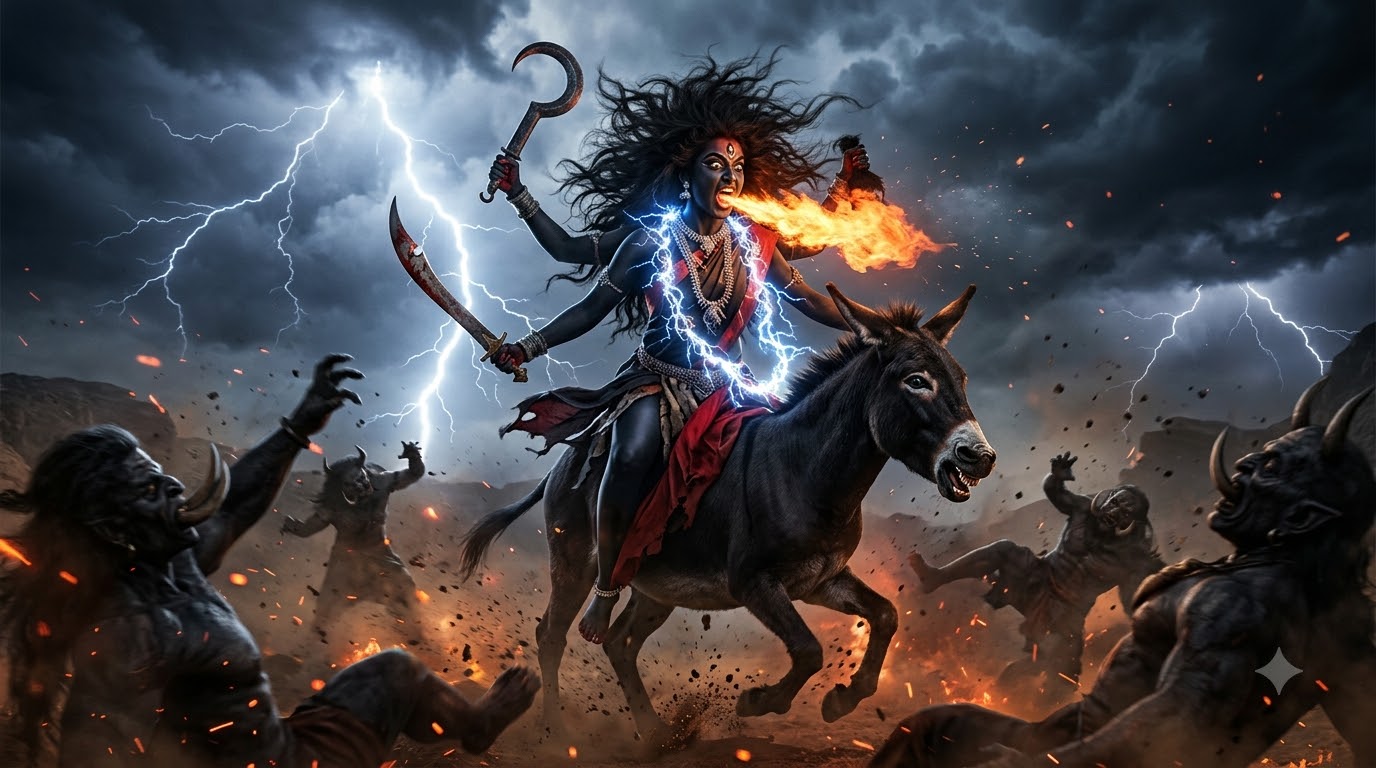
With disheveled hair, eyes flashing like lightning, nostrils exhaling flames, and mounted upon a wild donkey, she charged into the demonic ranks. When confronting Raktabija, she stretched her vast tongue across the battlefield, lapping up every droplet of his falling blood before it touched the earth while severing the demon's heads with her scimitar, terminating the cycle of duplication and saving the cosmos from total collapse.
एकवेणी जपाकर्णपूरा नग्ना खरास्थिता।
लम्बोष्ठी कर्णिकाकर्णी तैलाभ्यक्तशरीरिणी॥

Translation: Having a single braid of wild hair, adorned with red hibiscus flowers, riding upon a donkey, fearless and unfettered, may the fierce Goddess Kalaratri banish all shadows of darkness and dread.
Iconography and philosophical symbolism
Kalaratri’s shocking iconography is a profound spiritual teaching disguised as terror:
- The Jet-Black Complexion: Black is not the absence of light, but the absorption of all colors. In Shakta metaphysics, just as all colors disappear into black, all forms, names, and concepts eventually dissolve into the timeless void (Maha-Pralaya).
- The Donkey Mount (Kharastha): While other deities ride lions, tigers, or bulls, Kalaratri rides a humble donkey. The donkey is resilient, unglamorous, and accustomed to bearing heavy burdens, representing the radical subversion of aristocratic pomp and worldly pride.
- The Scimitar (Khadga) and Iron Hook: Her left hands wield a curved blade and an iron thorn, cutting away stubborn attachments and reeling in wayward minds.
- Abhaya and Varada Mudras (Shubhankari): Remarkably, her two right hands grant total fearlessness and supreme boons. Because she assures devotees that those who face the truth have nothing to fear, she is revered as Shubhankari ("the auspicious one").
- Sahasrara / Ajna Boundary: In yogic meditation, Kalaratri presides over the threshold between the intellectual eye (Ajna) and transcendental non-duality (Sahasrara). To cross this threshold, the ego must undergo psychological death.
What the evidence shows
Anthropologists and religious historians recognize Kalaratri as the survival of ancient, pre-Vedic subaltern and tribal deities incorporated into the high Puranic pantheon.
Her mount—the donkey—is associated in ancient Indian folklore with non-Brahmanical, apotropaic deities such as Nirriti (the Vedic goddess of decay and calamity) and Shitala (the folk goddess of fevers and epidemics). By integrating the donkey-riding deity into the core Navadurga cycle, Puranic compilers elevated marginal folk rituals into the heart of universal theology, acknowledging that divinity encompasses destruction, disease, and darkness alongside beauty and light.
Where experts disagree
Scholars debate whether Kalaratri represents a literal demon-slayer in historical tribal conflicts or an esoteric metaphor for deep psychological integration.
Jungian analysts view Kalaratri as the quintessential manifestation of the psychological "Shadow"—the unacknowledged, suppressed aspects of consciousness that human beings fear to confront. In this view, worshiping the terrifying goddess is an ancient method of catharsis and shadow-integration, stripping away neurotic fears of death.
Textual scholars, however, caution against over-psychologizing ancient rituals, emphasizing that early communities viewed her terrifying agency as literal protection against plagues, famine, and sorcery.
What we still don't know
The exact theological divergence between Kali, Chamunda, and Kalaratri remains complex and fluid in early manuscripts. While later ritual manuals assign them distinct days and iconography, in early versions of the Markandeya Purana, the descriptions of the goddess emerging from Durga’s brow oscillate between these three names without rigid boundaries.
Sources
- Coburn, Thomas B. Devi Mahatmya: The Crystallization of the Goddess Tradition. Motilal Banarsidass, 1988.
- McDermott, Rachel Fell, and Jeffrey J. Kripal (Eds.). Encountering Kali: In the Margins, at the Center, in the West. University of California Press, 2003.
- Kinsley, David. Tantric Visions of the Divine Feminine: The Ten Mahavidyas. University of California Press, 1997.
Evidence Labels
More like this
Navratri Day 6: Maa Katyayani, the Incarnate Wrath Born to Slay the Shapeshifter
The sixth night of Navratri honors Katyayani: the warrior born from the collective fury of the gods, brandishing the flashing sword Chandrahasa to defeat Mahishasura.
Navratri Day 8: Maa Mahagauri, the Radiant Serenity Born of Cleansing Waters
The eighth night of Navratri honors Mahagauri: the pristine goddess clothed in white, seated upon a white bull, embodying redemption and peace after battle.