Navratri Day 8: Maa Mahagauri, the Radiant Serenity Born of Cleansing Waters
On the eighth night of Navratri (Maha Ashtami), the fierce tempest of battle gives way to luminous, unblemished stillness. Maa Mahagauri—literally the "Great Radiant White One"—is the manifestation of supreme purity, spiritual renewal, and the healing calm that arises after profound struggle.
The story
According to the Shiva Purana, during Parvati’s thousands of years of solitary ascetic penance in the wilderness to attain Lord Shiva, her body was subjected to harsh mountain winds, scorching summer heat, and freezing winter blizzards. Layer upon layer of dust, wild vegetation, and smoke gathered upon her skin until her original complexion turned completely dark.
When Lord Shiva, deeply moved by her unshakeable endurance, appeared to accept her as his equal consort, he directed the sacred waters of the heavenly river Ganga to cascade over her form.
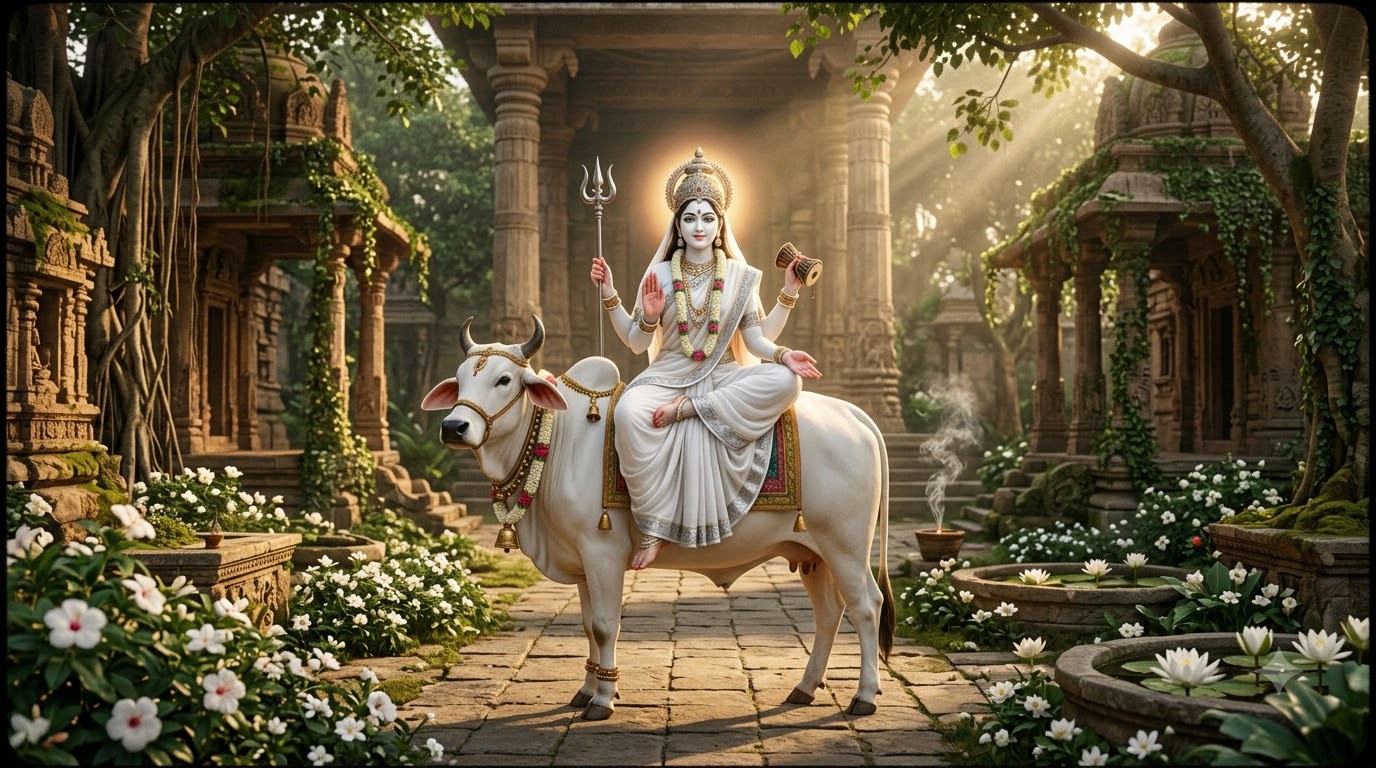
As the holy waters cleansed the accumulated soot of penance, her skin emerged with dazzling luminescence, shining like fresh mountain snow, white pearls, and lightning. Beholding her restored brilliance, Shiva named her Mahagauri ("She of the Great Fair Radiance"). She discarded all weapons of destruction, donning pristine white silk (Shvetambara) and returning to the celestial assembly as an emblem of cosmic serenity.
श्वेते वृषे समारूढा श्वेताम्बरधरा शुचिः।
महागौरी शुभं दद्यान्महादेवप्रमोददा॥

Translation: Mounted upon a noble white bull, adorned in pure white garments, immaculate and serene, may Goddess Mahagauri, who brings supreme joy to Mahadeva, grant auspicious peace upon me.
Iconography and philosophical symbolism
Mahagauri’s visual attributes represent the antithesis of the terrifying Kalaratri:
- Pristine White (Shveta): Clothed entirely in white garments and ornaments, she represents the Sattva Guna—the quality of lightness, truth, harmony, and uncorrupted clarity.
- The White Bull (Vrishabha): Her mount is a sacred white bull, mirroring the mount of Lord Shiva. The white bull signifies steady righteousness, patience, and non-violence (Ahimsa).
- The Trident and Damaru: In her four hands, she carries a trident (representing balanced tri-fold energy) and a damaru (the small two-headed drum whose rhythmic beat symbolizes cosmic order), while her other hands grant protection and boons.
- The Polarity of Kali and Gauri: In Shakta metaphysics, Kali and Gauri are not separate entities, but two phases of a single cosmic breathing cycle: Kali is the dark contraction and destruction of obsolete forms, while Gauri is the radiant expansion and compassionate renewal of conscious life.
- Soma Chakra / Sahasrara: She governs the lunar Soma center within the higher Sahasrara realm, radiating the cooling nectar of forgiveness, healing past psychological wounds and neutralizing karmic guilt.
What the evidence shows
Textual and art-historical records demonstrate that Gauri was one of the most widely venerated goddess names across ancient India, frequently celebrated in royal inscriptions, agricultural fertility rites, and domestic vows (Vratas).
In classical Sanskrit drama, such as Bhavabhuti’s Malatimadhava and Kalidasa's works, Gauri is invoked as the ideal of auspicious domestic harmony. Agricultural historians also observe that Maha Ashtami coincides with the harvest transition in northern and central India, where the dazzling white color of the goddess is associated with ripening grains, clear autumn skies, and the purification of community water reservoirs after monsoon floods.
Where experts disagree
Historians and cultural critics debate the symbolism of the goddess's darkening and subsequent whitening. Some contemporary post-colonial scholars critique the mythic emphasis on the transition from a dark skin tone (Kali) to a fair skin tone (Gauri), questioning whether medieval retellings reflected caste-inflected prejudices that associated lighter skin with moral purity.
Conversely, traditional scholars and Indologists argue that this critique misinterprets Sanskrit metaphysical language. In Puranic cosmology, Krishna (dark) and Shukla (white) denote cosmic phases—such as the waxing and waning moon or night and day—rather than racial phenotypes. The soot represents the physical toll of Tapas (friction and heat), while the white glow symbolizes the cooling of passion into crystalline wisdom.
What we still don't know
Archaeologists have yet to establish the exact historical period when Gauri separated into two distinct roles: as an independent, popular household goddess invoked by young maidens for auspicious marriage, and as the specific eighth deity within the formalized Navadurga system.
Sources
- Coburn, Thomas B. Devi Mahatmya: The Crystallization of the Goddess Tradition. Motilal Banarsidass, 1988.
- Kinsley, David. Hindu Goddesses: Visions of the Divine Feminine in the Hindu Religious Tradition. University of California Press, 1988.
- Doniger, Wendy. The Hindus: An Alternative History. Penguin Press, 2009.
Evidence Labels
More like this
Navratri Day 7: Maa Kalaratri, the Midnight Void and the Dissolution of Fear
The seventh night of Navratri honors Kalaratri: the ferocious destroyer of darkness who rides a donkey and dissolves the terror of mortality and time.
Navratri Day 9: Maa Siddhidatri, the Fount of Perfections and the Non-Dual Summit
The ninth night of Navratri (Maha Navami) honors Siddhidatri: the bestower of all mystical perfections from whom Lord Shiva derived Ardhanarishvara.