Navratri Day 9: Maa Siddhidatri, the Fount of Perfections and the Non-Dual Summit
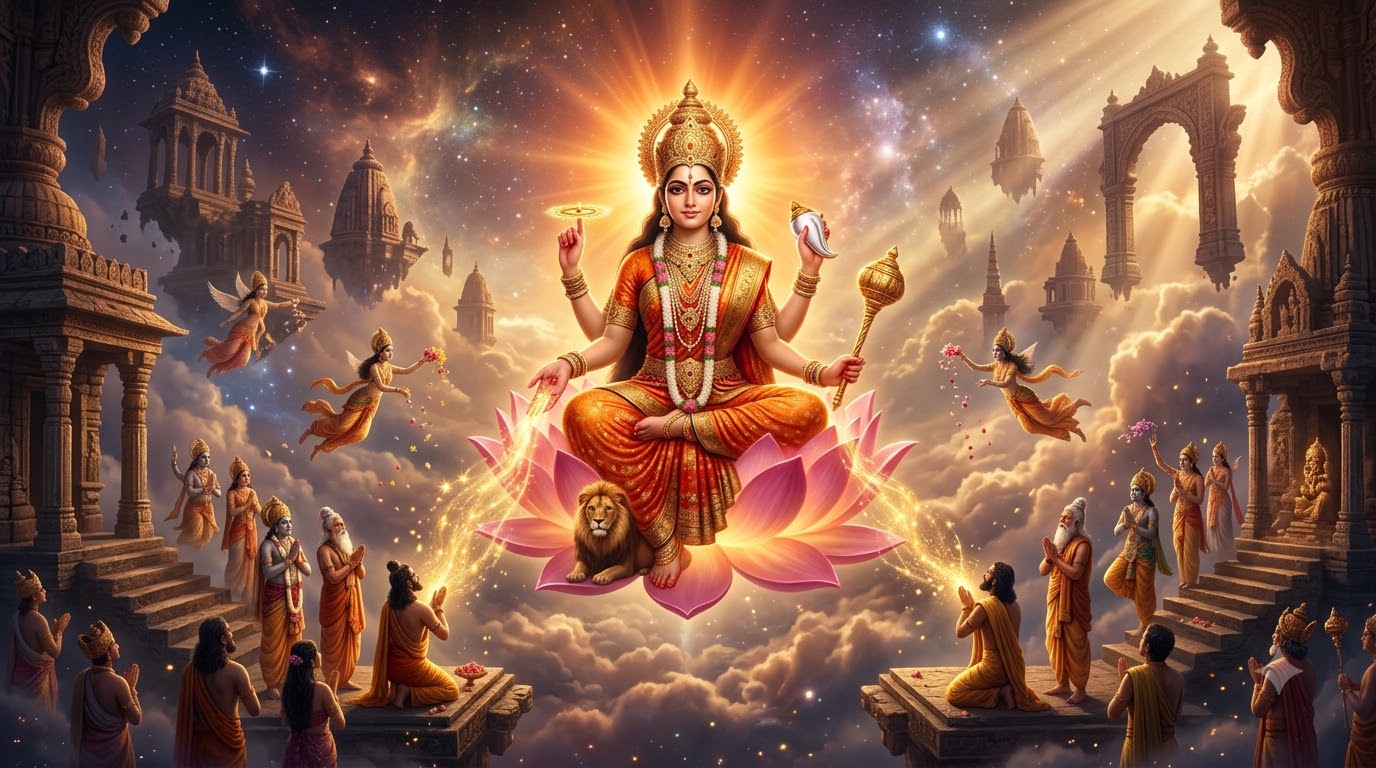
On the ninth and final night of Navratri (Maha Navami), the spiritual journey that began in the raw bedrock of the Himalayas reaches its non-dual summit. Maa Siddhidatri—literally "the Bestower of Perfections (Siddhis)"—is the supreme cosmic matrix from which all knowledge, supernatural faculties, and spiritual liberation (Moksha) emanate.
The story
According to the Devi Bhagavata Purana and Shiva Purana, in the primordial dawn before the manifestation of physical forms, Lord Shiva meditated upon the unmanifest supreme consciousness (the Great Goddess, Para-Shakti) to acquire the power necessary to orchestrate universal creation.
Pleased by his unceasing devotion, the Goddess manifested before him as Siddhidatri, bestowing upon him all eighteen mystical perfections (Siddhis)—including the primary Ashta Siddhis:
- Anima: Reducing physical consciousness to an atomic scale.
- Mahima: Expanding consciousness to cosmic proportions.
- Garima: Becoming infinitely heavy and immovable in truth.
- Laghima: Becoming weightless, transcending physical gravity.
- Prapti: Unrestricted access to any realm or dimension.
- Prakamya: Realization of all righteous desires.
- Ishitva: Absolute cosmic sovereignty and mastery.
- Vashitva: Universal attraction and harmony of opposing forces.
As she conferred these perfections, the Goddess merged half of her divine essence into Shiva’s physical form, transforming him into Ardhanarishvara—the composite deity half-man and half-woman. This profound mythology established that masculine consciousness (Purusha) remains inert, motionless, and incapable of creation without the vitalizing sanction of the feminine creative matrix (Prakriti).
सिद्धगन्धर्वयक्षाद्यैरसुरैरमरैरपि।
सेव्यमाना सदा भूयात् सिद्धिदा सिद्धिदायिनी॥

Translation: Constantly served and venerated by Siddhas, Gandharvas, Yakshas, Asuras, and Devas alike, may the supreme Goddess Siddhidatri bestow unhindered wisdom, mastery, and spiritual fulfillment upon me.
Iconography and philosophical symbolism
Siddhidatri’s iconography reflects completion, integration, and the fulfillment of all dualities:
- Seated upon the Lotus (Kamalasana): Unlike the combat stances of the preceding warrior days, Siddhidatri is seated peacefully upon a blooming thousand-petaled lotus, indicating that the wars of the ego have subsided into the tranquility of self-realization.
- The Four Vishnu Emblems: In her four hands, she carries the Discus (Chakra), Mace (Gada), Conch Shell (Shankha), and Lotus Flower (Padma). By holding the classical emblems of Vishnu while creating Ardhanarishvara with Shiva, she transcends sectarian divisions, demonstrating that all divine energies originate in the same supreme source.
- Sahasrara Chakra: She presides over the Crown Chakra (Sahasrara), the lotus of a thousand petals at the crown of the head. Here, the awakened Kundalini energy completes its ascent from the root (Shailaputri at Muladhara) to the crown (Siddhidatri at Sahasrara), dissolving all sense of separation between observer and universe.
What the evidence shows
Textual and sculptural evidence for the Ardhanarishvara concept associated with Siddhidatri dates back to the Kushan period (circa 1st–2nd century CE), with magnificent stone carvings discovered at Mathura and Elephanta Caves.
Historians observe that Siddhidatri represents the philosophical culmination of Shaktism’s triumph: rather than portraying the Goddess as an auxiliary consort serving a male god, the Puranas depict the supreme male deity worshipping her to attain his own competence. This represents a revolutionary ontological inversion of ancient patriarchal norms.
Where experts disagree
Philosophers debate the exact relationship between the attainment of worldly supernatural powers (Siddhis) and ultimate spiritual liberation (Mukti).
In classical Patanjali yoga (Yoga Sutras 3.37), Siddhis are explicitly treated as dangerous spiritual obstacles that distract the seeker from true liberation. Conversely, in Shakta Tantra, Siddhidatri’s gifts are not viewed as traps, but as natural byproducts of universal harmony: when a practitioner aligns completely with nature, the laws of nature spontaneously cooperate.
What we still don't know
The historical evolution of how the worship of Siddhidatri merged into the concluding feast of Kanya Pujan (venerating young pre-pubescent girls on Navami) remains an intriguing area of research. While the ritual of honoring living maidens as living embodiments of the Goddess is widespread across the subcontinent, the earliest textual mandates establishing this specific ritual on the ninth day remain difficult to date precisely.
Sources
- Vijnanananda, Swami (Trans.). The Srimad Devi Bhagavatam. Sudhindra Nath Vasu, 1921.
- Coburn, Thomas B. Devi Mahatmya: The Crystallization of the Goddess Tradition. Motilal Banarsidass, 1988.
- Kramrisch, Stella. The Presence of Siva. Princeton University Press, 1981.
Evidence Labels
More like this
Navratri Day 8: Maa Mahagauri, the Radiant Serenity Born of Cleansing Waters
The eighth night of Navratri honors Mahagauri: the pristine goddess clothed in white, seated upon a white bull, embodying redemption and peace after battle.
Maa Durga and the Nine Avatars: Symbolism of the Divine Feminine
An exploration of the Navadurga, the warrior goddess archetype, and her triumph over Mahishasura.