The Mystery of the Delhi Iron Pillar: How Has It Defied Rust for 1,600 Years?
The story
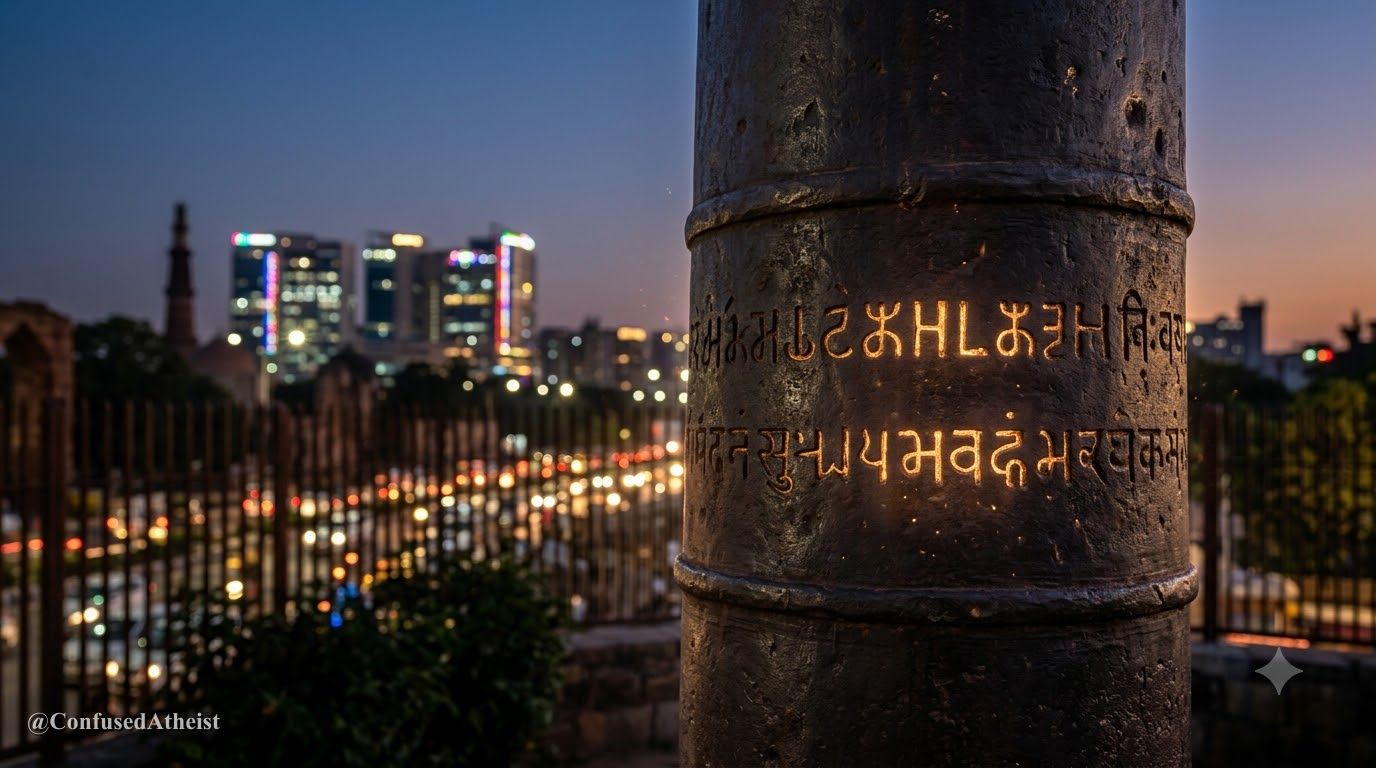
Standing in the courtyard of the Quwwat-ul-Islam mosque inside the Qutb complex at Mehrauli, Delhi, is a 7.21-meter-tall, 6,000-kilogram column of wrought iron. Across its surface is a six-line Sanskrit inscription in Gupta-era Brahmi script praising a monarch named Chandra (widely identified with Emperor Chandragupta II Vikramaditya, r. c. 375–415 CE), who erected the pillar as a Garuda-dhvaja (standard of Lord Vishnu) on a hill called Vishnupadagiri.
For centuries, travelers, colonial engineers, and internet commentators marveled at a seemingly impossible fact: despite standing outdoors through 1,600 monsoon seasons, the pillar exhibits almost no destructive corrosion above ground. Popular folklore attributed the phenomenon to lost extraterrestrial alloys or mystical alchemy.
What the evidence shows
The metallurgical mechanism behind the pillar’s corrosion resistance—and its Gupta-era manufacture by forge-welding wrought-iron blooms—is 🟢 Well-documented.
- High Phosphorus, Low Sulfur & No Manganese: Chemical and microstructural analyses led by Prof. R. Balasubramaniam at IIT Kanpur demonstrated that the pillar is not cast steel, but wrought iron averaging roughly $0.15%$ carbon and an unusually high $0.25%$ phosphorus (compared to less than $0.05%$ in modern blast-furnace steel). Ancient Indian bloomery smiths reduced iron ore using wood charcoal rather than coke, and they did not add limestone (calcium carbonate) as a flux. In modern blast furnaces, limestone slag removes phosphorus; without limestone, phosphorus remained dissolved in the metallic iron.
- The Passive 'Misawite' Film ($\delta\text{-FeOOH}$): When ordinary iron gets wet, porous iron oxides form and flake off, exposing fresh metal until the structure rusts through. On the Delhi pillar, the high phosphorus concentration at the metal-scale interface catalyzes the formation of a dense, amorphous, microscopic layer of misawite ($\delta\text{-FeOOH}$, an oxyhydroxide) enriched with crystalline iron hydrogen phosphate hydrate ($\text{FePO}_4\cdot\text{H}_3\text{PO}_4\cdot 4\text{H}_2\text{O}$). This compact barrier seals the underlying iron from atmospheric oxygen and moisture.
- Horizontal Forge-Welding: Visual and ultrasonic inspections show that the 6-ton shaft was built by heating and hammering together dozens of 20–30 kg pancake-shaped lumps (blooms) of hot wrought iron around a central mandrel.
Where experts disagree
While metallurgists agree on the phosphorus-misawite mechanism, historians and epigraphers debate two historical details:
- Original Location (Vishnupadagiri): Most epigraphers and archaeologists (such as Michael Willis and R. Balasubramaniam) identify Vishnupadagiri ("Hill of the Footprint of Vishnu") with the Udayagiri Caves near Vidisha/Sanchi in Madhya Pradesh—a major Gupta astronomical and Vaishnava site—arguing the pillar was moved to Delhi in the 11th century by Tomara king Anangpal or in the early 13th century under Iltutmish. A minority of scholars argue it was originally erected closer to the Delhi ridge or Mathura.
- Intentional vs. Empirical Alloying: Historians of technology debate whether Gupta ironsmiths consciously understood the chemical role of phosphorus or arrived at the high-phosphorus bloomery recipe empirically because charcoal-only smelting without lime naturally produced tough, forgeable, rust-resistant iron.
What we still don't know
Because non-destructive testing cannot sample the deep interior core of the buried base without damaging the monument, we still do not know the exact sequence of intermediate workshops that transported a 6-ton wrought-iron shaft hundreds of kilometers across northern India in the 5th century CE.
Sources
- Balasubramaniam, R. Delhi Iron Pillar: New Insights. Indian Institute of Advanced Study & Aryan Books International, 2002.
- Balasubramaniam, R. "On the Corrosion Resistance of the Delhi Iron Pillar." Corrosion Science, Vol. 42, No. 12, 2000, pp. 2103–2129.
- Anantharaman, T. R. The Rustless Wonder: A Study of the Iron Pillar at Delhi. Vigyan Prasar, 1996.
- Willis, Michael. The Archaeology of Hindu Ritual: Temples and the Establishment of the Gods. Cambridge University Press, 2009.
Evidence Labels
More like this
The Sacred Geometry of Temples: How Stone Architecture Mapped the Cosmos
From the 64-square Vastu Purusha Mandala to self-similar fractal shikharas and musical pillars, how classical Indian temples encoded geometry in stone.
Vedic Mathematics: The Origins
Is Vedic Mathematics truly ancient and found in the Vedas?